

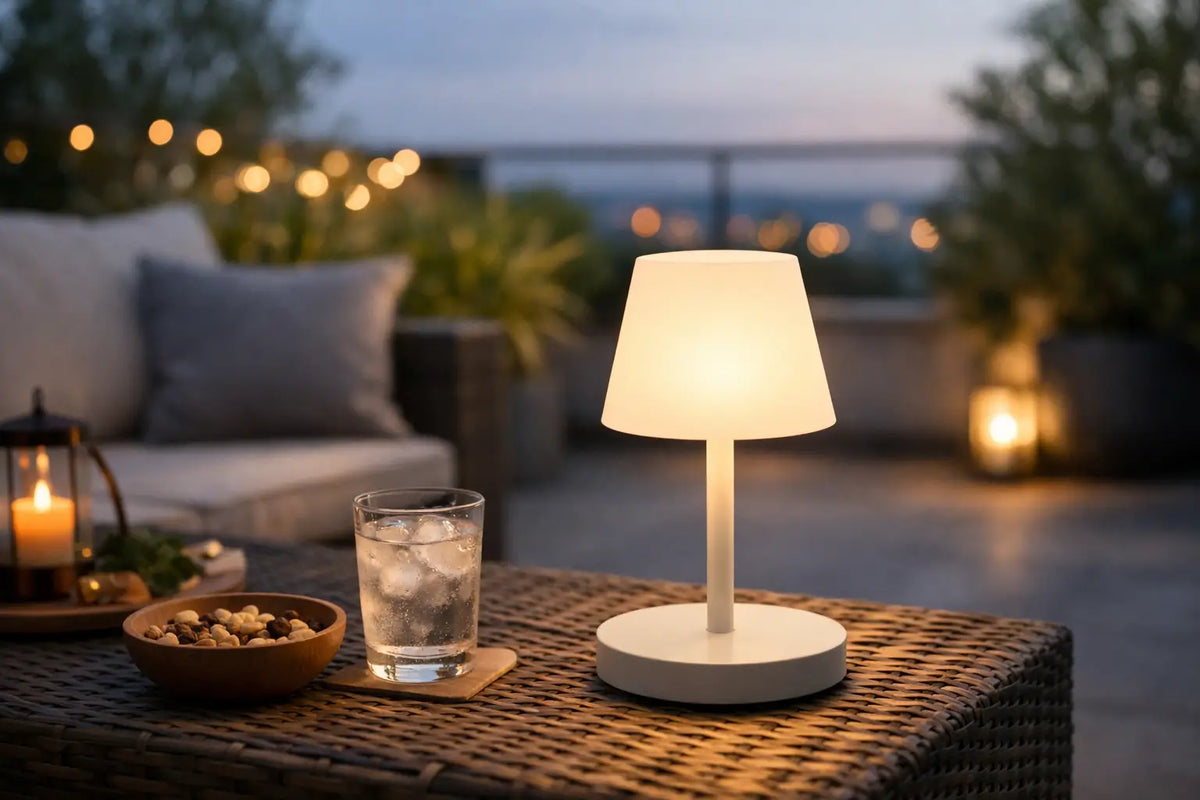
In the evening, the terrace often determines whether you stay outside for an extra drink or move indoors after dark. This is where a cordless terrace lamp has a huge advantage – you don't have to worry about cables, sockets, or complex planning of lighting points. Just place it where you want to create atmosphere, and the space suddenly feels more finished, cozier, and more thoughtful.
Moreover, cordless lamps are not just a practical replacement for traditional lighting. In a well-designed terrace, they function as a design element that can highlight seating, soften sharp corners of the space, or give an evening gathering a completely different energy. And that's their strength – they don't just illuminate so you can see, but to give the terrace character.
Why is a cordless terrace lamp so popular?
The reason is simple. People want outdoor light that adapts to the space, not the other way around. When you have a permanently installed wall or ceiling light, its position is fixed. You can move a cordless lamp next to a lounge chair, onto a dining table, by the hot tub, or onto stairs you want to visually soften in the evening.
This is appreciated not only by homeowners and apartment dwellers with terraces but also by cafes, bistros, and smaller establishments with outdoor seating. For a business, light is part of the impression. If the terrace glows correctly in the evening, guests stay longer, and the space feels more valuable. If the light is dim, harsh, or random, the atmosphere falls apart.
However, a cordless solution also has its limits. It's usually not the main light source for a large area. It works best as supplementary, mood, or zone lighting. Anyone who expects one lamp to illuminate the entire terrace like a spotlight will be disappointed.
How to choose a cordless terrace lamp based on real-world use
First, clarify what you actually want from the lamp. It sounds simple, but this is where most bad purchases happen. You need a different lamp for long summer dinners, a different one for ambient lighting by the door, and another for a stylish effect in the corner of the terrace.
If the lamp is to stand on a dining table, compact size and glare-free light are important. No one wants to stare into a harsh cone during dinner. Conversely, for a lamp next to a sofa set, you can opt for a more striking model that also functions as an object. Here, shape, material, and how the lamp looks when off play a role.
For larger terraces, it's often smarter to work with several smaller light sources rather than one dominant lamp. The resulting effect is softer, and the space feels more layered. One strong lamp often creates harsh shadows and an unnecessarily technical impression.
Battery life is not a detail, but a key parameter
With cordless lamps, people are often tempted by the look and forget about the operation. But a beautiful lamp that you have to charge after every evening will quickly become annoying. Therefore, observe the battery life during normal lighting mode, not just the maximum figure from the description.
The difference also lies in how you use the lamp. If you light it for two hours in the evening, even a shorter battery life will suffice. But if you want light for longer gatherings, weekend events, or for operation in the garden, look for a model that can handle several hours without compromising intensity.
It also makes sense to check the charging method. USB charging is convenient, but with some larger models, it can be slower. The ability to easily take the lamp indoors without complicated handling is also practical.
Outdoor protection determines how long it lasts
A terrace is not a living room. In the evening, there's humidity, sometimes rain, elsewhere wind, dust, or pollen. Therefore, it is important to observe the IP rating. For outdoor use, this is a more crucial piece of information than marketing phrases about durability.
If the lamp will often be under a roof, the requirements are somewhat milder. But if it stands on an open terrace, you need a model that can handle contact with water and changing weather. Here, improvisation does not pay off. An interior lamp might look good outdoors for the first week, but long-term, it's not a solution.
In addition to protection, also pay attention to the material. Metal looks elegant, but not all types are suitable for outdoor use. Plastic might sound ordinary, but a quality finish is often light, durable, and practical on a terrace. For designer lamps, it's ideal when appearance meets carefree use.
Light temperature creates atmosphere
Few people want cold white light reminiscent of an office or warehouse on their terrace. Outdoor seating usually works best in warmer tones that soften faces, wood, textiles, and the surrounding greenery. It is precisely the light temperature that determines whether the terrace feels pleasant or impersonal.
Warm light is a sure bet for evening relaxation and guests. A more neutral shade can work where you need slightly more practical illumination, for example, at an outdoor dining table. Much also depends on the surrounding materials. Concrete, anthracite, and metal often work better with balanced warm light than with a distinctly yellow tone.
For premium models, dimming or the ability to change intensity is an advantage. This is precisely the detail that makes a difference in practice. You need a different mood for dinner, a different one for a quiet evening with a drink, and a different one for a small garden party.
The lamp's design must suit the terrace, not the trend
Almost anything can look great in a photo. But a real terrace has its style, proportions, and materials, and a cordless lamp should fit into them. Not necessarily unobtrusively – it can certainly be a statement piece – but it must make sense.
On a modern, minimalist terrace, clean lines, matte surfaces, and simple shapes work well. In boho or naturally styled spaces, softer forms, textures, and soft light are more prominent. For city balconies and smaller terraces, a compact model that doesn't overwhelm the space is often better.
It's also good to consider how the lamp will look during the day. If the terrace is visible from the living room, the light is part of the overall impression even when it's not lit. This is why it pays to choose with both your eyes and your reason.
Where a cordless terrace lamp will work best
Placement matters more than performance itself. If you place the lamp in the middle of the space without connection to furniture or zones, the effect is lost. It works much better when the light supports a specific place – a dining area, a lounge seating area, a corner with flowers, or the transition between interior and exterior.
On a table, the lamp creates a more intimate atmosphere and connects people around one point. On the ground, it can model the space and add depth to the terrace. A taller floor variant helps where you want to create a more prominent visual accent.
In a commercial space, it's ideal to also consider how the terrace looks from the outside. Light should attract attention, not dazzle. A well-chosen lamp can be a small detail that decides whether a guest notices your establishment.
Most common mistakes when choosing
The first mistake is underestimating the size. A small lamp gets lost on a large terrace, and a large lamp on a small balcony looks cumbersome. The second mistake is chasing the strongest possible light. The outdoor atmosphere isn't about power, but about balance.
A common problem is also a poor estimation of maintenance. Light surfaces can be beautiful, but outdoors, dirt will show up on them faster. Some materials also require more care to maintain their appearance. If you want a light that will primarily serve, choose a model with simple maintenance.
And then there's the classic mistake – choosing a lamp in isolation, without regard to other lighting. A terrace works best as a whole. If you already have wall lights, string lights, or facade lighting, the cordless lamp should complement the whole, not fight with it.
When you want more than just light
A well-chosen lamp changes behavior in a space. People sit elsewhere, stay longer, the terrace feels cozier and more presentable. And that's exactly why you shouldn't treat the selection as just a technical purchase. Light is part of the atmosphere, and this is doubly true for outdoor spaces.
If you're looking for a solution that will look stylish and also work in everyday use, it's worth combining design, durability, and the right lighting effect. This is precisely how a terrace is created that not only looks good in photos but is truly enjoyable to live in. And once you hit the right atmosphere in the evening, you won't want to go back to harsh light and cables.