

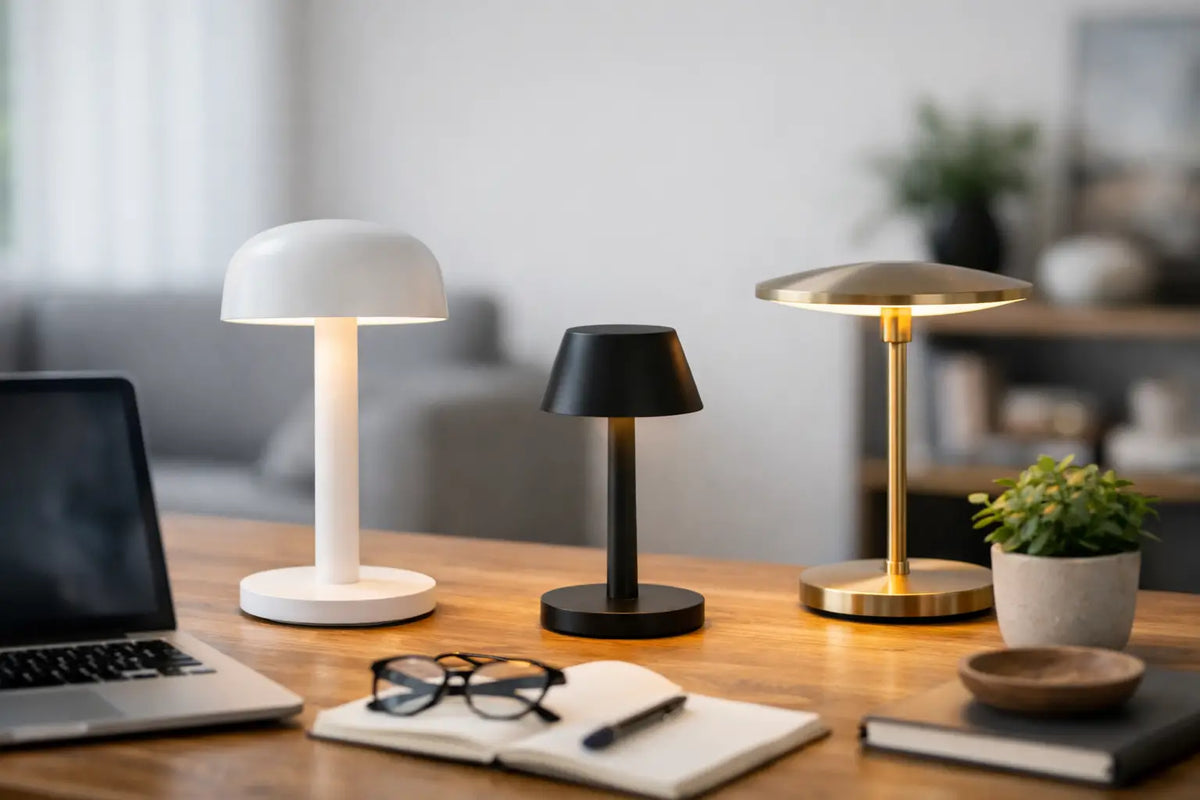
A cable across half the table, a distant outlet, and light exactly where you want it – that's the situation where wireless table lamps make immediate sense. They are not just a practical replacement for a classic lamp. They can be a distinctive interior detail, a source of pleasant ambiance, and a clever solution for places where a cable would hinder more than help.
That's why their popularity is growing in homes, cafes, hotels, and smaller establishments. One well-chosen lamp can transform a reading nook, a nightstand, a desk, or an outdoor seating area. And because with this type of light, it's not just about appearance, but also about battery life, intensity, and ease of use, it pays to choose with a clear idea in mind.
Why wireless table lamps are so popular
The main advantage is clear at first glance – freedom of placement. You place the lamp where it makes sense for the space, not where the cable reaches. This is a huge difference, especially in modern interiors, where clean lines are used and nothing should disturb the overall impression.
Wireless table lamps also appear lighter and more elegant. There's no visual clutter on a dresser, shelf, or coffee table. If you're concerned about the room's atmosphere, it's a detail that surprisingly greatly influences the final feeling.
Equally important, however, is practicality. You can easily move the lamp from the living room to the bedroom, from the desk to the terrace, or from the interior to an establishment for an evening event. For homes, it's convenience; for businesses, it's flexibility. And it's the combination of style and mobility that makes them much more than just an accessory.
Where they fit best
In the home, wireless lamps can be used almost everywhere. On the nightstand, they create soft light without distracting cables around the bed. In the living room, they act as subtle layered lighting that complements the main ceiling light and adds depth to the space. On the dining table or dresser, they help build mood, not just illuminate.
They also work great in children's rooms, where easy handling and a safer solution without a loose power cord are beneficial. In a workspace, it depends on the specific model – some lamps can provide full working illumination, while others are more supplementary.
In catering establishments, salons, or reception areas, wireless table lamps play another strong role. They help create the identity of the space. On restaurant tables, they appear cleaner than classic corded lamps. In a boutique or studio, they can highlight a selected product, an interior detail, or a brand's mood. Light here is not just a backdrop. It's part of the impression one takes away.
What to focus on when choosing
Battery life matters more than it seems
Design often sells first, but in real operation, battery life wins. If you only want to use the lamp occasionally in the evening for ambiance, a shorter operating time per charge will suffice. But if you're looking for light for regular evening reading, a desk, or an establishment, you need a model that will truly last several hours without compromise.
It's important to note the intensity at which the manufacturer states the battery life. Some lamps can operate for a long time only at a lower brightness. At full power, the actual lighting time can be significantly shorter. This is where the difference between an effective accessory and a light that will truly work every day becomes apparent.
Light intensity and color change the atmosphere
Not every light has the same task. Warm light creates a calmer, more intimate atmosphere and is suitable for the bedroom, living room, restaurant, or evening gatherings. Neutral light is more universal and works better where you want to combine aesthetics with practicality. Cooler shades are more suitable for specific work use, but can appear too harsh in a residential interior.
A great advantage is the dimming capability. Thanks to it, one lamp can be used in multiple modes – from soft evening glow to brighter light for reading. If you want the lamp to be not just pretty, but also truly useful, intensity control is a very sensible choice.
Size and proportions must suit the space
A lamp might look great in a photo, but in a real interior, dimensions are key. On a small nightstand, an overly robust model will unnecessarily clutter the space. Conversely, a tiny lamp on a large dresser can easily get lost and lose its effect.
It's good to consider not only the height, but also the diameter of the lampshade or base. If the lamp will be moved frequently, stability and weight also play a role. A lightweight model is more comfortable to handle, while a heavier one usually feels more valuable and sturdy.
Charging method affects daily convenience
Charging is often a detail that customers address only later. Yet, it determines whether the lamp becomes a beloved part of the interior or something you're constantly looking for and charging at the last minute. Models with USB charging are practical, ideally with a commonly available cable. With some lamps, a charging base is a welcome feature that simplifies regular use.
If you plan to use the lamp in a business or move it frequently, convenient charging is almost as important as the appearance itself. Any unnecessary complication will quickly become apparent in daily operation.
At Home
Aesthetics, soft light, simple controls, easy portability between rooms.
In Business
Durability, longer battery life, stability, and easy maintenance even for the entire evening service.
Design is not a bonus, but a reason for purchase
With wireless lamps, design cannot be separated from function.
They are visible. They stand in places where they create mood, and often also serve as decoration. Therefore, it's good to choose a model that harmonizes with the materials, colors, and character of the space.
For a minimalist interior, clean shapes, matte surfaces, and simple lines are suitable. If the room has a softer, cozier expression, lamps with a gentler silhouette and warmer light work well. Modern commercial spaces can often tolerate a bolder piece that grabs attention at first glance and becomes part of the visual identity.
This is when light ceases to be just a necessity. It begins to work with emotion. It attracts attention, enhances the atmosphere, and helps the space appear well-thought-out. This is precisely why, when choosing, it pays not to just focus on parameters, but also on how the room should feel in the evening, during a visit, or when you want to make an impression.
Wireless table lamps for home and business are not the same
At first glance, they may look similar, but the needs of a home and a business differ. At home, people often look for a combination of aesthetics, pleasant light, and ease of use. In an establishment, durability, stability, longer battery life, and easy maintenance are added requirements.
For example, a lamp on a restaurant table must look good even after extended use, must not disturb guests with overly harsh light, and ideally should last the entire evening service. In a salon or reception, it's important that it highlights the brand and doesn't look cheap. For home use, there's usually more room for playfulness, decorativeness, or a gentler lighting effect.
So, if you're choosing based on a photograph, it's good to first clarify what you really expect from the lamp. Atmosphere is always important, but the conditions of use change what will work in practice.
When does investing in a higher quality lamp pay off?
A cheaper model may initially seem like a quick and advantageous solution. However, if the battery starts to weaken over time, the controls don't respond reliably, or the craftsmanship doesn't withstand normal use, the initial savings quickly disappear. With wireless lamps, quality is particularly evident with regular use.
A higher investment makes sense when you expect more from a lamp than just occasional illumination. That is, if it's meant to be a stable part of the interior, a brand accessory, an element of evening ambiance, or a light that you will move between different zones. Here, it's no longer just about the product. It's about impression, comfort, and long-term functionality.
This is precisely the power of well-chosen lighting. It doesn't take up unnecessary space, doesn't disrupt the composition, and yet changes how you feel in the room. Whether you're furnishing an apartment, studio, or business, light has the ability to bring the whole together into its final form. With brands like AtmoSvetla, it makes sense to view lighting precisely this way – not as a technical detail, but as an element that adds character to the space.
When choosing, don't just look for a lamp without a cable. Look for light that fits your rhythm, supports the atmosphere, and works exactly where it needs to be seen most.