

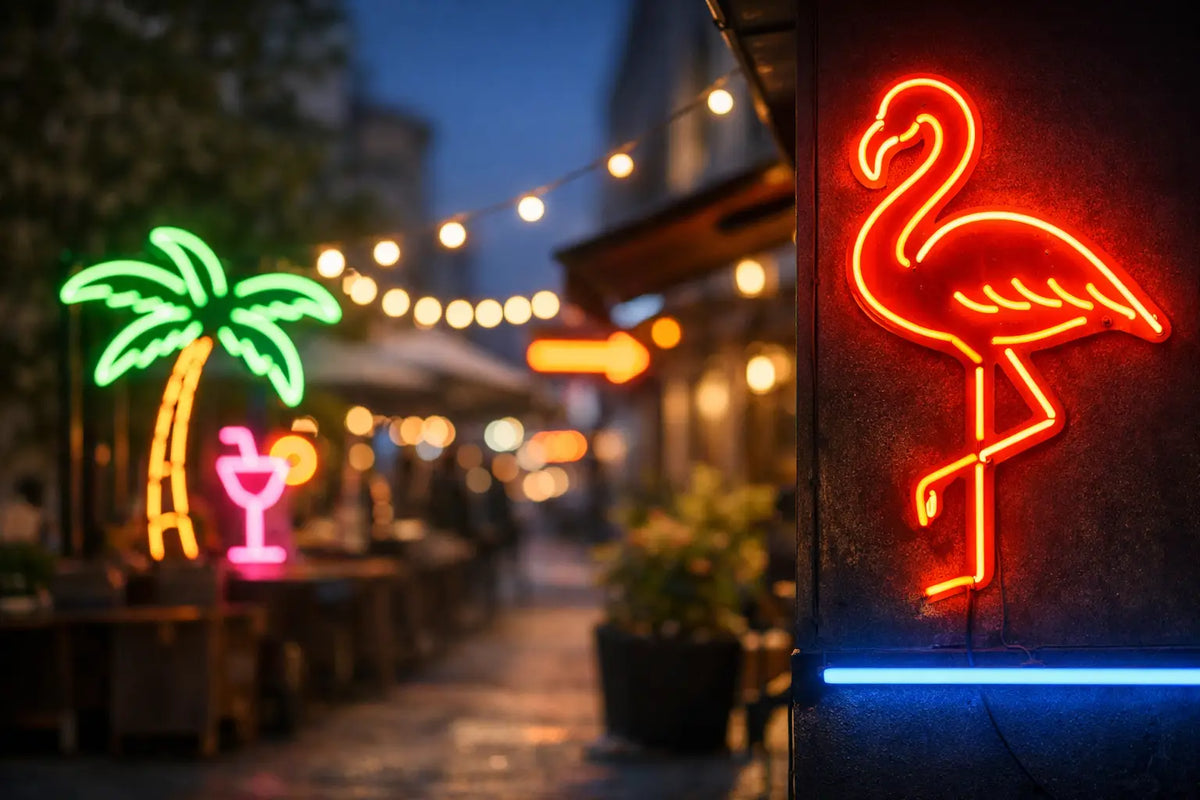
Rain on the storefront, morning frost in the garden, summer sun on the terrace. These are the conditions that often give rise to the most common question: can neon be used outdoors? Yes, but an outdoor installation cannot simply be an indoor LED neon moved outside. For the sign to glow for a long time, look clean, and function safely, it must be designed for the specific location from the start.
Outdoor neon can transform an inconspicuous entrance into a prominent feature. It gives a cafe evening energy, adds personality to a salon, and creates an atmosphere on a terrace that makes guests stay for an extra drink. But the details that are not visible at first glance are crucial: IP rating, power supply, substrate material, mounting, and where water falls.
When neon can be used outdoors without compromise
An LED neon sign can be a great outdoor choice if it has adequate water and dust protection. This durability is described by the IP rating. The higher the second digit, the better the product is protected against water ingress. For a covered location where the sign is not directly exposed to rain, milder parameters may suffice. However, signs on facades, fences, garden pergolas, or freestanding structures require a solution designed for outdoor use.
It's not just about the illuminated silicone profile itself. The joints, wiring, power supply, connectors, and the point where the cable enters the sign must also be durable. A single unprotected joint can degrade an otherwise well-prepared installation.
It is essential to distinguish whether the sign will be under a roof or fully exposed to rain. A sign above an entrance under a deep awning faces different conditions than a luminous logo on a south-facing facade. Similarly, a terrace protected by a pergola is not the same as an open garden. The correct answer is therefore never just "yes" or "no," but "yes, when we know exactly where the neon will be placed."
Rain is not the only enemy of outdoor neon
Water is usually the first thing customers consider. However, temperature changes, UV radiation, wind, and mechanical stress are equally important for the long life of the sign. Outdoor installations in the Czech Republic must withstand summer heat, night frosts, and periods when humidity lingers in the air for weeks.
Sunlight can affect the appearance of lower-quality materials over time. Therefore, it is important to choose components suitable for outdoor use and not underestimate the placement. If the sign is in direct sunlight all day, it makes sense to address its contrast as well. Light is primarily visible in the evening, but during the day, the design must still function as part of the facade or space.
Wind, in turn, tests the mounting. Lightweight neon lettering on an acrylic substrate does not weigh much, yet it needs sturdy anchoring appropriate for the wall material. Otherwise, it can vibrate in gusts, strain cables, or gradually loosen. For large logos, signs at height, and installations in publicly accessible areas, it is worth thinking everything through before production, not just when drilling.
Choose the location before the color and font
Outdoor neon is a visual magnet, but it works best where it has a clear role. For a business, it can guide guests to the entrance, highlight a takeout window, mark a photo booth, or become a signature of the terrace. At home, it can illuminate a pergola, a garden bar, a workshop, or a covered balcony. Each of these spaces requires a slightly different approach.
Before choosing the shade and text, answer three practical questions: Will the sign be directly exposed to rain? Where will the power supply be safely located? And will the sign be clearly legible from where people are supposed to see it? The answers will affect the technical design and the final impression more than the choice of font itself.
For a business, it pays to observe the customer's route. A sign that is beautiful but hidden around the corner will not enhance brand visibility. Conversely, a simple logo or a short word at the right height can attract attention from the street and give the place its own character. Neon doesn't have to shout. It must be legible, memorable, and naturally belong to the space.
Conceal the power supply, but don't forget access
Outdoor LED neon usually operates at low voltage, but the power supply unit must be protected from moisture and safely located. The power supply should not be on the ground, in standing water, or exposed to rain without protection. The ideal location is a covered, ventilated, and accessible space where it can be reached for inspection without dismantling the entire sign.
A common mistake is to address the power supply only after the design is complete. The result is often a visible cable running across the facade or an improvised box that spoils the clean design. Therefore, it is good to determine from the beginning of the design where the power will come from and how the cable will be discreetly hidden. A well-thought-out installation looks better day and night.
How to tell if the design is prepared for outdoor use
When ordering, it's not enough to just specify the text and preferred color. State whether it's an open facade, a covered terrace, a balcony, or a garden structure, approximate dimensions, and the substrate material. A photo of the location is also helpful. This allows assessing whether the sign needs a different size, a more striking shade, or a safer mounting method.
A well-prepared outdoor design considers several things at once: the durability of the components used, legibility from the correct distance, cable routing, the type of substrate, and the final aesthetic. The goal is not to add as much light as possible. The goal is to create an element that shines in the evening and acts as a quality part of the architecture during the day.
For a custom sign, it is often worthwhile to simplify the motif. Very fine lines, miniature fonts, and too many details can be difficult to read from a distance. A shorter slogan, a distinctive silhouette, or a well-crafted logo generally have a greater effect outdoors. For a bistro, a glowing "OPEN" may suffice, for a salon an elegant symbol, and for a garden corner a personal inscription that transforms an ordinary wall into a scene for evening gatherings.
Installation determines how long the sign will glow
Even a high-quality outdoor sign will not forgive poor mounting. The type of mounting must correspond to the surface – it is anchored differently in a solid wall, wood, a metal structure, or an insulated facade. For the latter, it is especially important not to damage the insulation system and to choose appropriate anchoring elements.
Also, do not place the sign where a stream of water regularly flows from the gutter or where snow lingers for a long time. If possible, leave space around the sign for air circulation and easy cleaning. Dust, pollen, and common dirt can usually be removed with a soft, damp cloth. Aggressive cleaning agents, pressurized water, and unprofessional interventions in the electrical installation, on the other hand, can damage the material and connections.
For larger installations or commercial facades, it is sensible to entrust the wiring and mounting to a professional. This is not an unnecessary complication, but a way to protect the investment, operational safety, and the clean final appearance.
Light that works even after closing time
Outdoor neon has an advantage that an ordinary sign does not offer: it works for your brand precisely when the surroundings darken. An illuminated sign becomes a landmark, a backdrop for photos, and a detail that people associate with visiting your place. In a home setting, it can even transform an ordinary outdoor seating area into a personal zone with its own atmosphere.
If you are thinking about your own sign, don't start with just the question of what will be written on it. Start with the place where it is supposed to glow and the conditions that await there. Send your idea and a photo of the space – AtmoSvetla will help turn it into a luminous element that will look great even when the rain comes.