

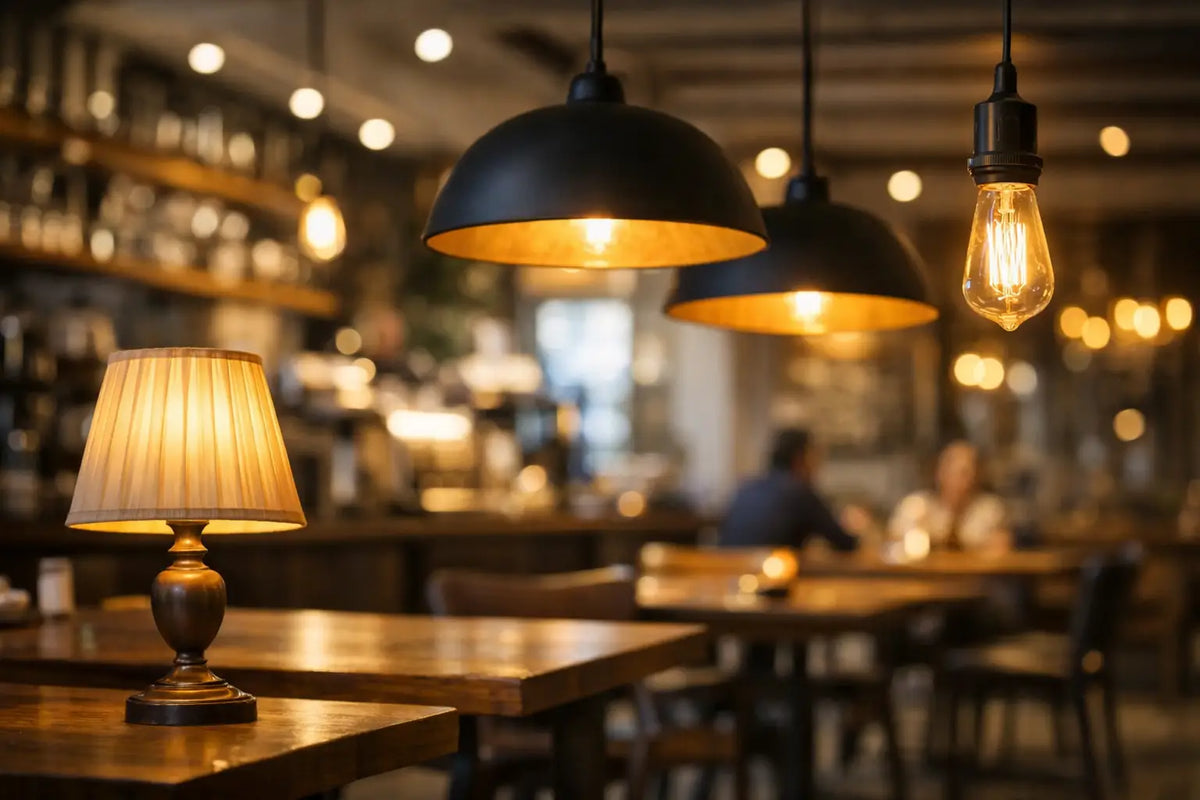
A guest might not remember the exact shade of your wall. But they will remember how they felt at your place, holding a cup, finding a spot by the window, and taking a picture of their cappuccino. That's why the best lamps for a cafe are not just an item in the equipment budget. They are part of the experience that determines whether a guest stays for one more coffee and whether they return.
A cafe needs lighting that can work in layers. It should be functional enough for the staff, flattering for guests, precise at the display case, and distinctive where you want to show off your character. A single central ceiling light won't solve this task. A well-lit space, on the other hand, looks thoughtful, photogenic, and naturally guides attention where you need it.
The best lamps for a cafe start with dividing the space
First, don't look at a specific lamp model, but at what happens in individual parts of the cafe. The bar needs a different atmosphere than a small table for two, and a shelf with packaged coffee needs yet another. If you light every zone the same way, the space will be flat and without rhythm.
At the entrance, light welcomes. It can be a little more prominent so that the guest immediately reads the establishment's name, menu, or dominant decoration. Above the bar, you need quality task lighting that doesn't distort the color of milk, desserts, or ingredients for the barista. The customer perceives it as part of the operational energy – a clean, bright bar inspires confidence.
Seating has the opposite task: to slow down the pace. A pendant lamp lower above the table creates a small private island even in a busier room. Guests then don't feel like they're in a waiting room, but in a place that belongs to them for a while. In corners, by benches, and in areas with armchairs, wall lights or floor lamps work great. They provide soft, indirect light without glare.
The display case, product shelves, and an art piece on the wall need accent lighting. Directional spotlights or a track system will highlight the offerings and add depth to the interior. This is a practical detail with commercial impact: what is clearly visible sells more easily.
Light temperature matters more than decorative bulbs
In most cafes, warm white light in the range of approximately 2200 to 3000 K works best. It feels pleasant, highlights wood, ceramics, pastries, and coffee tones, and doesn't resemble an office. A lower value around 2200 K creates a more intimate, almost evening mood. It's excellent for a wine bar, an espresso bar with a darker interior, or an establishment that stays lively after dark.
For a daytime cafe with faster guest turnover, 2700 to 3000 K is often more practical. The space will still remain warm but won't lose its freshness and clarity. Neutral light can also be used at the workstation bar, but ideally, it should not appear cold from the guests' perspective. Often, it's enough to separate the light for work from the light perceived by customers sitting at tables.
Be careful with visible filament bulbs. They are effective and belong in industrial or retro interiors, but they shouldn't be the main light source themselves. If you use too many, the space can be dark, uneven, and tiring for the eyes. Treat them as jewelry, not as the sole answer to lighting the entire cafe.
Choose the lamp type according to the establishment's character
Pendant lamps are a natural choice above tables and bars. They can optically divide space, add height, and create a clear visual signature. In a minimalist cafe, simple metal or glass shapes will stand out. In a natural-themed space, rattan, fabric shades, or opal glass that gently diffuses light work well.
If you want to shift the interior towards a contemporary urban style, work with black metal, smoked glass, linear luminaires, or more distinctive geometric forms. Instead of one giant lamp above a long table, an arrangement of smaller pieces sometimes works better. The light is distributed more evenly, and the installation gains a rhythm that guests perceive even in photos.
Wall lights save spaces where a pendant lamp would be in the way or where you need to add depth to an empty wall. They are suitable for tables along the wall, in hallways, and by mirrors. Choose luminaires with shielded or indirect light so that guests don't look directly into the light source.
Table and cordless lamps are small details with a big effect. On evening tables, they create intimacy, are easy to move, and allow for dimming the overall lighting without sacrificing comfort. They are ideal for cafes that function as a workspace during the day and transform into a social gathering spot in the evening. It's worth monitoring battery life, base stability, and easy charging – operations don't have time to deal with lamps that die every two hours.
Light must flatter people, food, and photographs
Poorly chosen light can unnecessarily drown even a beautiful interior in shadows. Too harsh spotlights create circles on tables and unpleasant shadows on faces. Strong overhead light, on the other hand, can make guests look like tired versions of themselves. Softer, diffused sources supplemented by side light are much more flattering for seating areas.
At the display case and with products, also pay attention to color rendering accuracy. A dessert under poor light can look grayish, even if it's fresh and perfectly prepared. For gastronomy, it makes sense to choose light sources with a high color rendering index, ideally CRI 90 or more. The guest may not know the technical parameter, but they will see the difference.
Don't forget about natural light. Large windows are an advantage, but they change the intensity and color of the space throughout the day. Therefore, choose lamps so that the cafe looks great not only at ten in the morning but also on a winter evening. Dimmable circuits are one of the smartest investments in this regard. In the morning, they provide energy, in the afternoon they balance the shadows, and in the evening they create a calmer scene.
The design effect should have a clear reason
A distinctive lamp can be the element that makes people associate your establishment with a specific atmosphere. However, it must have space to breathe. If you place several different dominant elements next to each other, add colorful LED strips, and complement them with a striking neon sign, the result can be more visual noise than identity.
Choose one main theme. It could be a series of pendant lamps above the bar, a repeating curved shape, a material linked to the furniture, or a light-up sign that gives the space its own voice. A neon sign with a short phrase, the cafe's name, or a simple symbol works best on a wall that isn't cluttered with other decorations. During the day, it's part of the interior; in the evening, it takes on the role of a landmark and a motif for sharing on social media.
Custom lighting makes sense, especially when you want to connect the interior with the brand without the space looking like an advertising billboard. At AtmoSvetla, you can send an idea, logo, or mood you want to evoke, and turn it into a custom lighting element. A good design doesn't start with the question "where do we put the neon," but "what should the guest take away from here."
Common mistakes that strip a cafe of its atmosphere
The most common mistake is too much light on one circuit. When everything lights up at once, you have no way to react to the weather, time of day, or occupancy of the establishment. The second mistake is ignoring reflections. Glass, glossy table surfaces, the POS screen, and the display case can reflect light unpleasantly exactly where you don't want it.
Another common problem is the incorrect height of pendant lamps. Too high, they lose intimacy; too low, they obstruct the view, and staff can bump into them. Above a dining table, the bottom edge of the lamp is usually best at approximately 60 to 75 centimeters above the tabletop, but the final setting is always influenced by the size of the fixture, ceiling height, and type of seating.
Don't try to save money by choosing only based on appearance. In operation, ease of maintenance, material durability, availability of spare parts, and safe placement also matter. A paper shade can be beautiful, but it may not be practical near an open kitchen or in a dustier environment. The best solution is one that remains beautiful even after hundreds of morning rushes.
When choosing lamps, walk through the cafe during the day, in the rain, and in the evening after closing. Imagine the guest, the barista, and your next social media post. Light that can handle all three perspectives doesn't just illuminate the room—it gives your establishment a reason to stop by.