

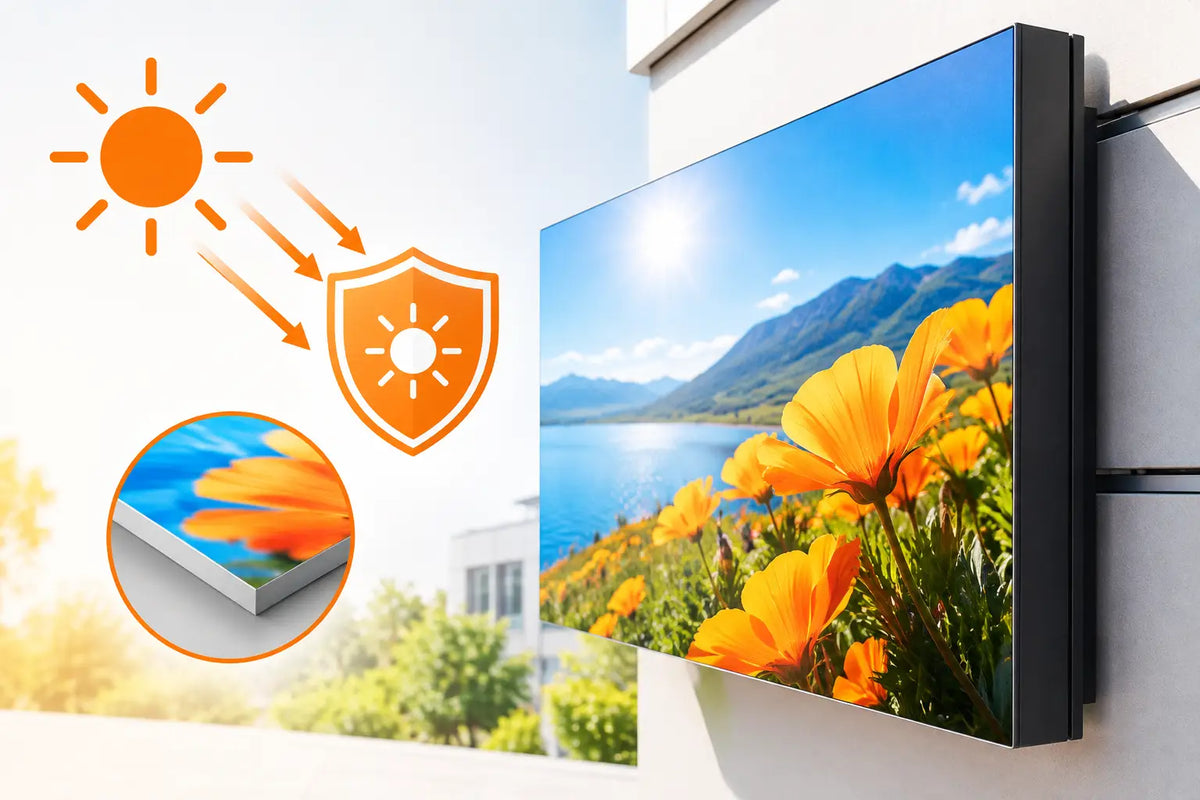
A logo on a facade shouldn't just function on the day of installation. It needs to attract the gaze of passersby even after several seasons, enduring all-afternoon sun, alternating rain, frost, and street dust. It is precisely the durability of UV printing that determines whether your graphics remain distinct, legible, and worthy of your brand, or if they begin to lose their energy before customers even notice them.
UV printing is popular for advertising signage for a good reason. It allows for fine details, solid colors, photographs, and precise corporate shades to be applied to acrylic, metal, or other suitable surfaces. However, the designation "UV" itself does not mean that every printed surface can handle the same conditions. True longevity is an interplay of technology, material, sign construction, and the location where you place the advertisement.
What UV print durability means in practice
In UV printing, ink is cured by UV light almost immediately upon application. This creates a solid color layer that adheres well to a correctly chosen substrate and allows for a sharp, visually clean result. You will appreciate this especially with logos, fine lettering, icons, QR codes, or graphics intended to complement 3D plastic lettering.
Durability, however, is not a single characteristic that can be expressed by one number. In advertising practice, we primarily address colorfastness, resistance to moisture and mechanical abrasion, and the ability to maintain adhesion to the substrate. A sign in a covered cafe entrance faces completely different stresses than a wayfinding sign on a south-facing facade or a light box by the road.
Sunlight is usually the greatest test. UV rays gradually decompose color pigments, so saturated shades, in particular, may lose depth over time. The change is usually not dramatic from one day to the next. That makes it all the easier to overlook, until you install a new sign next to it and see the difference between a fresh brand and a tired-looking surface.
Where UV printing works best
UV printing makes a lot of sense where you need to combine precise graphics with striking design. In interiors, it is used for logos, decorative panels, navigation signs, bases for LED neon, or the graphic parts of light advertisements. In a protected space, the stress is lower, and therefore you can focus more on the colors, texture, and overall atmosphere.
Outdoors, UV printing is suitable for signs, shop signage, information boards, and graphic elements of light boxes, provided the design is adapted to the specific conditions. For a restaurant under an awning, elegant printed acrylic can be exactly what creates a recognizable entrance. However, for a surface exposed to direct sun, wind, and rain, it is necessary to assess the material, the method of attachment, and any protective layer.
An interesting effect arises from the combination of UV printing and light. A printed base can carry a colorful logo or illustration, while the space is complemented by LED neon, a glowing sign, or a backlit 3D logo. The light does not overwhelm the graphics - it gives them a new character in the evening and lets the bright colors and details do the work during the day.
The material matters more than it seems
The same motif will behave differently on acrylic, metal, and composite board. Acrylic looks modern, clean, and goes well with light-based advertising. It is suitable for fine graphic applications, transparent or colored surfaces, and constructions where the material is intended to remain part of the design.
Metal, on the other hand, brings a more solid, technical, or premium expression. It can be the right choice for company signage that is meant to appear stable and professional. Here, surface preparation and well-thought-out execution are important so that the print adheres well and the whole looks high-quality even up close.
When choosing, it's not just about looks. Material reacts differently to heat, humidity, and expansion than the printed layer itself. If the board heats up and cools down significantly throughout the year, the construction must account for this movement. A high-quality advertising sign is not just a nice print - it is a well-designed whole.
What can shorten the life of outdoor printing
Surfaces oriented to the south and southwest are the most stressed. They receive a long dose of direct sun, often when the material is heated to a high temperature. The difference between a common decorative application and a solution designed for the exterior will also manifest more quickly.
It is not just sun rays that pose a risk. Dust and smog can gray the surface, salt stresses advertisements in traffic-exposed areas, and water can get into poorly protected joints. For a sign at hand level, also add daily touches, scratches from bags, or harsh cleaning.
Problems can also arise in the design phase. Very fine, light text on a heavily colored background may look subtle in a preview, but it will lose legibility from a few meters away and in sharp light. Similarly, photographic gradients or extremely thin lines are not always ideal for signage that is meant to function quickly and from a distance. Good advertising should not force the customer to guess who you are.
How to design a sign that will hold its color and attention
Start with the location, not just the logo. Is the sign under a roof or directly on the facade? Does afternoon sun hit it? Will the customer watch it from the sidewalk, from a car, or only from the door? The answers will influence the size, contrast, material, and choice between a printed board, a light box, and 3D letters.
For outdoor graphics, bright color areas, sufficient contrast, and font with room to breathe work best. You don't have to give up originality. On the contrary – a striking motif, a well-chosen color, and clever lighting can create a place that people will remember. The design just needs to hold up under the noon sun, not just on a screen.
For light boxes, watch how the graphics will behave both during the day and in the evening. During the day, the brand must appear clean and legible without the help of light. After dark, the illumination should support the logo, not erase fine details or change the perception of colors. Sometimes it is better to simplify the background and let one strong element shine in the evening.
If you combine UV printing with LED neon, don't clutter the area. Neon can highlight a slogan, outline, or symbol, while the printed graphics create the context. This combination works excellently in bistros, salons, studios, and spaces that want to be photogenic and easily shared.
Maintenance without unnecessary risk
Even durable printing does not need aggressive chemicals. For regular cleaning, a soft, non-abrasive cloth and a gentle agent suitable for the given material are usually sufficient. Rough sponges, solvents, or high pressure can damage the surface sooner than the weather would.
It is worth checking the sign occasionally, especially after winter or strong winds. This applies not only to the printing itself, but also to the mounting, edges, and joints. Timely removal of dirt and inspection of the construction will keep the advertising space looking representative – exactly as your brand should appear before the first meeting with a customer.
At AtmoSvetla, we design advertising elements based on what the space needs to say and where the brand will actually function. We prepare designs and price quotes for free within 12 hours, and there is no limit on design revisions. Thanks to this, it is possible to resolve not only the appearance but also practical questions of material, placement, and legibility before production begins.
Before you send a logo to production, take a photo of the installation site during the day, note the orientation of the facade, and think about where people will see you first. This simple preparation is often what decides whether your UV print will be just a decoration or a part of an identity that truly lets you stand out.