

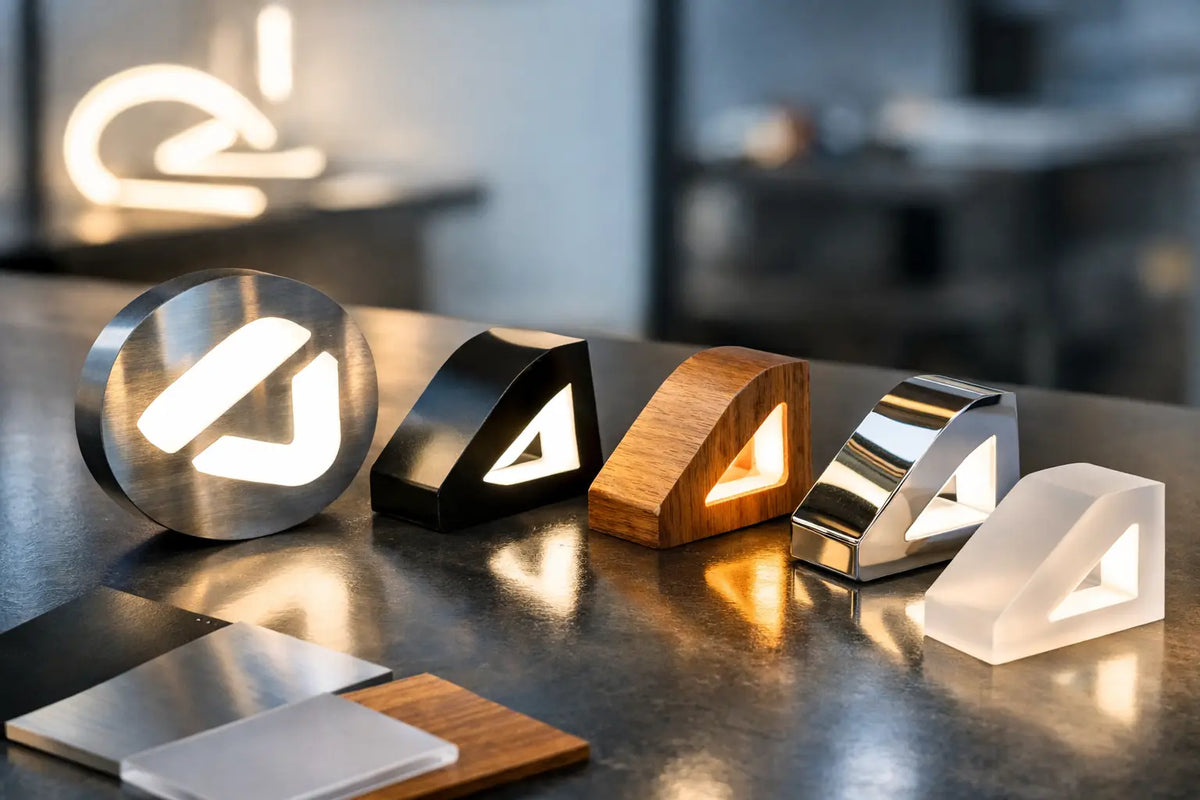
A lit logo is not just a sign that lights up after dark. It's the first visual signal that helps a guest recognize a cafe, a customer find a showroom, and a passerby remember a brand. That's why comparing materials for a lit logo is more important than it might seem. The material determines not only the final appearance, but also the depth of the lettering, the character of the light, its durability, and whether the logo will appear premium, playful, or more technical.
There isn't one universally best material. A subtle logo for a beauty studio needs a different energy than a prominent sign above a bistro, a company reception, or an outdoor store sign. The right choice begins with asking what the logo should achieve in the space: subtly enhance the atmosphere, or attract attention from across the street?
Comparing materials for a lit logo by impression
When choosing, the main focus is often on the LED color or the size of the sign. However, the material determines how the light will interact with its surroundings. It can shine directly into the space, subtly reflect off the wall, or create a sharp contrast with the background. And each of these effects speaks a different language for the brand.
Acrylic: clean look and light in the starring role
Acrylic is one of the most popular choices for modern lit logos. It can be clear, milky, colored, glossy, or matte. Its biggest advantage is its ability to transmit and diffuse light, making it ideal for illuminated letter faces, light boxes, and more delicate decorative applications.
Milky acrylic creates a soft, even light without distracting hotspots. Clear acrylic, on the other hand, appears light and elegant - especially when complemented by UV printing, a colored background, or engraving. Indoors, acrylic can look very clean and contemporary, which is appreciated by salons, creative studios, offices, and design shops.
However, it's good to keep in mind that fingerprints and dust can be more visible on glossy surfaces. For outdoor installations, it's also necessary to consider a quality structure, sealing, and mounting method. Acrylic is a visually strong material, but it works best when the design is simple and the light has plenty of space to shine.
Dibond: a solid base for a sharp logo
Dibond is a composite panel with an aluminum surface and a solid core. At first glance, it may not shine as effectively as acrylic, but its strength lies elsewhere: it creates a precise, stable, and professional base. It is often used for panels with illuminated elements, milled letters, UV printing, or as a support surface for LED neon.
Matte dibond in black, white, anthracite, or brushed metal can give the logo a striking contrast. The illuminated element then doesn't appear as an extra decoration, but as a natural part of the identity. This is a very good approach for restaurants, receptions, fitness studios, shops, and brands that want a clean result without visual clutter.
Dibond is also durable and suitable for outdoor use. The disadvantage is that it does not transmit light on its own. If the logo is to be brighter, it needs to be combined with an acrylic face, LED neon, or a well-designed backlighting. However, the result can appear significantly more valuable than a simple illuminated sign on a wall.
PVC and Komatex: lightweight solution for interiors
Foamed PVC, often referred to as Komatex, is a lightweight and affordable material. It is excellent for processing, can be cut into letter shapes and larger panels, and works well as a base for LED neon logos or UV printing. For interiors, it offers many possibilities without the basic construction absorbing the entire budget.
It is suitable, for example, for photo booths, home game rooms, children's rooms, cafe walls, or temporary promotional installations. In white, it looks unobtrusive; in black, it provides contrast to the text; and a colored panel can support brand identity even without complex printing.
Its limitation is lower durability compared to dibond or metal. It is not always an ideal choice in high-traffic areas where impacts are likely, or in outdoor environments. PVC makes the most sense where lightness, quick installation, and a good balance between price and visual effect are key.
Metal: a logo with character and depth
Metal elements add structure, weight, and expression to a lit logo. Aluminum, stainless steel, or painted metal are primarily used for 3D letters, side constructions, and faces that are meant to look premium. A metal logo doesn't have to be fully illuminated. For example, the halo backlighting effect, where light emanates from behind the letters and creates a glow around their outline, is very impressive.
This style suits hotels, architectural offices, beauty clinics, premium services, and brands with a minimalist identity. Metal also works well on facades and can withstand harsher conditions. The reward for a higher investment is a long-lasting, representative result.
However, for a delicate handwritten font or a colorful playful motif, metal can seem unnecessarily harsh. Here, LED neon on an acrylic or PVC board often works better. The material should support the character of the logo, not overpower it.
Direct illumination or wall glow?
The same material can look completely different depending on the type of illumination. Direct illumination through an acrylic face is ideal where maximum readability is needed – typically above a bar, at an entrance, or on a facade. Colors are rich, the logo is unmissable, and it works well in photos and videos.
Backlighting is more subtle. The letters optically separate from the wall, and an elegant light outline is created around them. This effect requires a quality background and sufficient distance from the wall for the glow to spread out. On dark Dibond, a wooden wall, or smooth plaster, it can look exceptionally good.
LED neon is a separate chapter. The flexible silicone tube allows for continuous strokes, motifs, and handwritten signs that have the energy of classic neon without its fragility. It stands out best on a clean acrylic or PVC background, or directly on the wall if the construction allows for elegant cable concealment.
What to consider before production
Before ordering, it helps to clarify whether the logo will be indoors, outdoors, or in a transitional space. Outdoor installations must withstand rain, sun, dust, and temperature changes. Material is only one part - equally important are correctly chosen LED components, protection rating, power supply, and mounting.
The second question is the background. On a light wall, white backlighting can get lost, while on a dark surface, it gains dramatic depth. If the wall is textured, brick, or paneled with wood, direct lighting often ensures better readability than a subtle halo effect.
The third point is the size and distance from which the logo will be visible. Small details in a logotype can disappear in a small format, especially with 3D construction. Sometimes it is therefore better to adjust the graphics for the illuminated version rather than sticking to the original file at all costs. A good lit logo is not just a scaled-down version of a logo from a business card.
How to choose a material without compromising the result
If you want a lightweight, modern, and colorful interior sign, start with acrylic or PVC with LED neon. For durable outdoor signage and clear contrast, Dibond combined with illuminated elements makes sense. If the logo is to represent a premium brand and the space calls for detail, metal 3D letters with backlighting will create exactly the kind of glow that will endure for years.
The best implementations usually don't come from selecting a single material from a catalog, but from a clever combination. Acrylic provides light, Dibond creates a solid frame, metal adds depth, and UV printing helps bring color or detail to the design. At AtmoSvetla, all you need to do is send your idea, logo, and a photo of the location – the free design will show how a specific material can transform an ordinary wall into a point that people will associate with your brand.
A lit logo should be seen, but most importantly, it should be felt. Choose a material that will not only hold the light in place but will give your atmosphere a clear shape.