

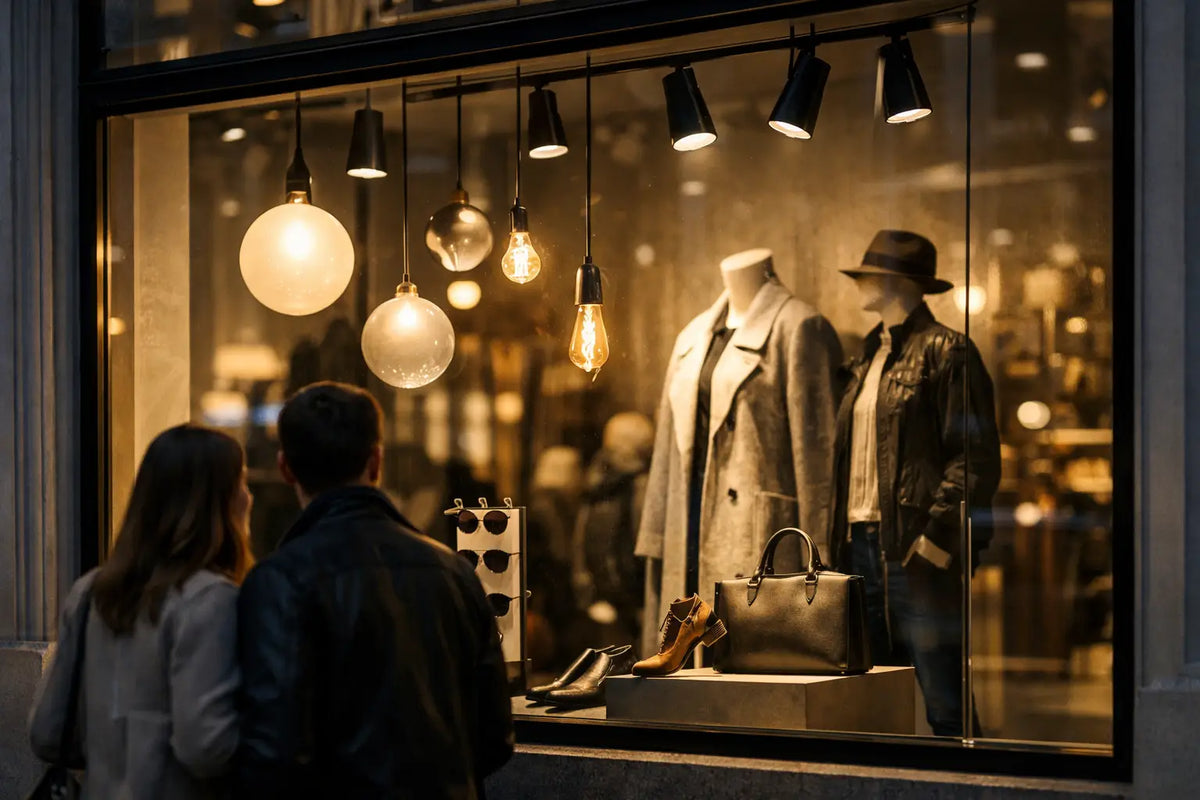
A storefront has only a few seconds to influence a passerby's decision. Trending shop window lighting can turn a casual glance into a pause, curiosity, and, ideally, a step across the threshold. It isn't just about shining brighter than the shop next door. The window must sparkle in the evening, remain readable during the day, and, above all, communicate in an instant why a person should enter your store.
Trending shop window lighting is more than just decoration
Light in a shop window is part of your sales strategy. In a café, it can create a sense of warmth and an appetite to stay longer. In a boutique, it highlights the texture of materials, collection colors, and small details that would vanish under standard ceiling lights. In a salon or studio, it creates an impression of precision and contemporary style even before the customer sees the list of services.
The biggest shift in recent years is that a shop window no longer needs to feel like a cluttered display case. It works more like a well-composed scene. It has a main motif, plenty of space around it, and light that leads the eyes in the right direction. Fewer products, but better lit, often sell more than ten items without a clear hierarchy.
Trends are not a mandate for every business to shine purple or use neon. They make sense when they support the brand's character. A minimalist hair salon needs a different atmosphere than a night bistro, a flower shop, or a sneaker store. Good light doesn't look like an extraneous accessory; it looks like it has belonged to the space from the beginning.
Neons, logos, and short messages work at first sight
LED neon signs are among the most visible elements because they combine light, color, and emotion. A short message is usually most effective: the name of the business, one distinctive word, a motto, or a simple symbol. Passersby don't have time to decipher long text. They should remember the atmosphere and have a reason to return.
For a café, a handwritten-style "coffee first" sign might work; for a beauty salon, an elegant illuminated logo; and for a restaurant, a bold motif that looks good in guests' photos. Photogenic details carry business value today. If a visitor takes a photo of the space and shares it, the window works even beyond the street.
However, you must monitor readability. Fonts that are too thin, too many colors, or several light messages next to each other start competing for attention. The neon should be the hero of the scene, not another layer of visual noise. For custom production, it is worth having the design prepared based on the actual width of the window, the distance from the sidewalk, and the ambient light.
An illuminated logo must have room to breathe
Backlit 3D logos add depth and a professional impression to a window, especially for brands that want to appear cleaner than a classic neon. Daylight shows the material and shape of the letters, while after dark, a soft glow forms around them. This is a strong choice for showrooms, clinics, salons, real estate agencies, and more premium retail.
The size of the logo is not determined only by the available glass area. It also depends on the speed at which people move. On a busy street, the motif must be larger and simpler than in an arcade where customers walk more slowly. If a brand offers multiple services, don't try to list them all in the window. A logo and one clear message have more power than a small catalog on the glass.
Three layers of light create a window with rhythm
An impressive shop window usually doesn't rely on a single light source. It works with three layers: base light, accents, and mood. The base ensures products don't disappear into shadows. The accent highlights the main attraction—a mannequin, a new model, a dessert, a bouquet, or a specific product. The mood layer then adds the space's signature, for example, in the form of a soft LED strip, a table lamp, or an illuminated sign.
This composition solves a common problem: strong overall light may reveal everything, but the window then looks flat and tired. Conversely, a decorative neon without product lighting might attract a look, but it won't show what you are actually selling. Light should be able to do both—create emotion and support the offer.
For products with glossy surfaces, watch out for reflections in the glass. A light fixture positioned directly against the window can create a bright spot that prevents seeing inside. It is better to direct the light diagonally from above or the side. For jewelry, cosmetics, and glass, small, precisely aimed accents help, while clothing needs softer and more uniform color rendering.
Color sells the mood, but must not distort reality
Warm white around 2700 to 3000 K creates coziness. It suits wood, baked goods, coffee, interiors with textiles, and brands that want to appear personal. Neutral white is more universal for fashion stores, cosmetics, or modern studios because it keeps product colors truer. Cooler tones can work for technology, sports, or futuristic aesthetics, but they easily make a space feel inhospitable.
Colored light should be used purposefully. One signal color in a neon, backlight, or detail creates a memorable point. Five colors at once often turn a window into chaos, especially next to a busy road. The exception is businesses whose identity is bold, playful, and visually loud. Even there, you need a clear composition, not a random mix of effects.
Color rendering index is also important. For fashion, flowers, food, or decorations, shades should look natural. A customer who takes away a different impression from the window than after entering the shop will not have the feeling of a job well done. Nice light should be effective, but also honest.
Dynamics yes, flashing chaos no
Gently changing intensity, slow dimming, or subtle color transitions can bring a shop window to life. Movement attracts the eye, which is why it has its place in gastronomy, arcades, creative studios, or with younger fashion brands. However, it should complement the main message, not drown it out.
Rapid flashing, aggressive strobing, or constantly changing text looks cheap and can be annoying to passersby and neighboring businesses. Moreover, they reduce readability. It is better to create one calm, repeatable effect that people associate with your brand. Light should attract, not attack.
A practical advantage of LED solutions is the ability to dim. A window doesn't have to shine with the same intensity at eight in the morning, during the evening rush hour, and after closing time. In the evening, you can increase intensity, and after hours, dim it to an energy-saving mode. However, don't forget to check local house, center, or heritage zone regulations, especially for prominent facade installations.
The window must work both during the day and after dark
Many designs look great in evening visualizations but disappear into glass reflections during the day. That is why it is good to test solutions in both modes. During the day, contrast helps—a darker background behind a light sign, a more prominent logo outline, or correct product placement away from the strongest street reflections. In the evening, the time comes for glow, depth, and soft light layers.
Also, think about maintenance. Dusty glass, damaged stickers, and irregularly lit elements can devalue even an expensive project. A shop window is a business card open 24 hours a day. Every detail says how you care for your brand and your customer.
For custom projects, it pays to handle the design, production, and installation as one unit. AtmoSvetla turns ideas into LED neon signs, illuminated logos, or custom decorations and offers design and consultation for free. Turnkey installation can be arranged throughout the Czech Republic, but specific scope and conditions should be confirmed before payment.
Let your window say one powerful thing. Send us your idea, brand, or just the atmosphere you want to create—and we will transform it into light that no one will walk by without noticing.
Transparency note: This text was created with the support of generative artificial intelligence and was editorially edited for the needs of AtmoSvetla.