

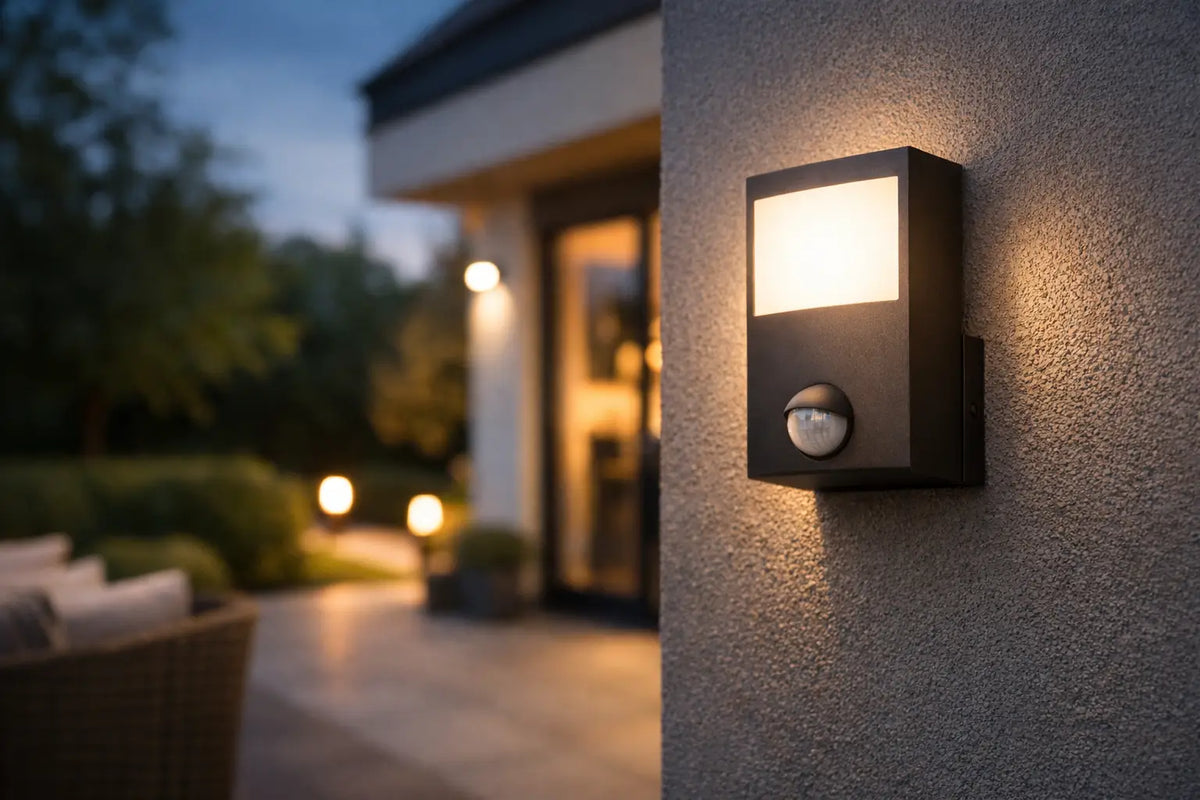
When you return home in the evening with bags in your hands, and the light by the door comes on exactly when you need it, it's a small detail with a big impact. This is the power of a solution like an outdoor wall light with a sensor. It's not just about practicality. A well-chosen light can enhance security, make coming home more pleasant, and simultaneously give the facade a cleaner, more thoughtful look.
For outdoor lighting, it's not just about performance. It's about a combination of function, appearance, and proper placement. And with a sensor light, it's worth thinking about the selection a bit smarter than just what looks good in a product photo.
Why an outdoor wall light with a sensor makes sense
On the facade, at the entrance, next to the garage, or on the terrace, light has only one task – to work at the right moment and without unnecessary switching. A sensor saves both time and energy because the light doesn't stay on all night for no reason. It turns on when it detects movement or a decrease in ambient light intensity, depending on the type of sensor you choose.
The practical benefits are clear. You don't need to search for a switch, guests can find the door more easily, and the unlit corner next to the house no longer feels abandoned. In addition, such lighting also has an aesthetic effect. Light activated at the right moment appears more natural than a constantly illuminated facade, which can be unnecessarily harsh and distracting.
For many households, the safety aspect is also important. Motion-activated light can deter an unexpected visitor and simultaneously reduces the risk of tripping on a step or not seeing the lock. It's not a replacement for a security system, but as a smart first layer, it works very well.
Where a sensor light has the greatest effect
It is most commonly installed by the entrance door, at side entrances, by the gate, on the wall next to the garage, or on the terrace. Each of these places has slightly different logic, and that should determine the selection.
At the main entrance, the goal is comfort and representation. Here, it's good to look for a model that not only provides good light but also harmonizes with the house's architecture. In a modern exterior, clean geometric shapes usually work well, while in a more classic environment, a more subtle design with a softer light output is preferred.
For the garage and driveway, the sensor's range and higher light output are often more important. You need to cover a larger area and detect movement in time. On the terrace or near seating, on the other hand, softer light is usually better, so it doesn't glare every time someone moves around the table.
This is where the saying "one size fits all" doesn't apply. One outdoor wall light with a sensor might be ideal for the door, but too harsh or sensitive for a relaxation area.
How to choose the right sensor type
Not every sensor reacts the same way, and not every one is suitable for the same place. Most commonly, you'll encounter motion sensors that react to changes in space. For everyday use around the house, they are usually the most practical. They turn on the light when someone approaches and turn it off again after a set time.
It is important to monitor the range and detection angle. If the sensor is too sensitive and points to a sidewalk or street, the light may turn on unnecessarily often. This is unpleasant and also reduces the comfort of use. Conversely, too narrow a range can mean that the light turns on late, only when you are already directly at the door.
Some models allow you to set not only the lighting duration but also the sensitivity or the ambient light level at which the sensor is activated. This is a great advantage. Thanks to this, the light will not turn on during the day or with every slight movement of leaves in the wind.
If you want even greater control, it's worth looking at models with a combination of motion and twilight sensors. These work smarter and are more practical in places where you don't want unnecessary activation during the day.
Performance, light color, and why lumens aren't enough
Lumens are important, but they don't tell the whole story on their own. For an entrance area, you usually don't need extremely strong light. Too high a power can be rather unpleasant, especially when it turns on all at once and directly in your eyes. Better is light that illuminates the space clearly, but doesn't appear aggressive.
The color of the light also matters a lot. Warmer white creates a more pleasant atmosphere and suits living areas, terraces, and house entrances. Neutral white looks more technical and is suitable where you need better orientation or sharper perception of details, such as at a garage, service entrance, or longer side passage.
The way the light shines is also important. Some lights primarily direct light downwards, others combine upward and downward illumination, and others spread light over a wider area. This fundamentally influences the resulting impression on the facade. If you want the house to appear not just lit, but truly thoughtfully illuminated, choose based on the light effect as carefully as on the color or material.
Protection, material, and outdoor durability
The outdoor environment is uncompromising. Rain, dust, frost, summer heat, and direct sun will test a light faster than indoor use. Therefore, pay attention to the IP rating. For typical outdoor placement, it's reasonable to aim for at least IP44, and even higher in more exposed areas.
Material also matters. Metal lights can look premium and clean, but they should have a high-quality surface finish. Plastic, on the other hand, can be light and practical, but it's important to ensure it resists UV radiation well in the long term and doesn't become brittle. Glass elements look great, but in some operations, they can be more demanding to maintain.
If the house is exposed to wind, rain from the side, or if the light is mounted close to the ground, it's not worth cutting corners. With outdoor lighting, a cheaper option is often only cheap to buy, not to use.
Design is not a bonus, but part of the function
Outdoor light is one of the first things you notice on a house after dark. Not just you, but also visitors. Therefore, it makes sense to treat design as seriously as technical parameters.
A minimalist facade goes well with simple lines, matte black, anthracite, or a clean white light body. A house with natural materials often appreciates softer shapes and light that doesn't cut the space into sharp contrasts. If the entrance is smaller, a too massive light can appear heavy. On a large wall, a tiny model will visually disappear.
In short, light does more than just switch on in the dark. It creates the exterior atmosphere and helps the house show its character. That's precisely why it's worth choosing it as part of the overall impression, not as the last item on the list.
What to watch out for when placing
Even a quality light can function poorly if it's badly placed. A typical mistake is mounting it too high. The light then looks effective, but the sensor reacts late or inaccurately. Another common problem is directing the sensor into an area where cars, people on the sidewalk, or tree branches move.
At the entrance, an ideal height is one that illuminates the lock, handle, and the area underfoot well. For a longer passage, it's better to consider where a person is coming from, so the sensor detects movement in time. If you're dealing with a larger exterior, sometimes a combination of several weaker light points makes more sense than one strong one.
It's also worth thinking about what the light will do from an interior perspective. Too strong or poorly oriented light can unpleasantly penetrate windows in the evening and disrupt comfort inside the house.
When to choose a simple solution and when to put more effort in
If you are looking for a light for a back entrance or a technical part of the house, reliability, durability, and a reasonable price might be the main priorities. However, if you are choosing a light for the main entrance, a terrace, or a modern facade, aesthetics and the character of the light also play a bigger role.
This is where the difference between ordinary lighting and light that truly completes the space becomes apparent. Brands like AtmoSvetla are built on the idea that light is not just a technical accessory, but part of the atmosphere. And this applies to the exterior as much as the interior.
A correctly chosen outdoor wall light with a sensor won't just save you a few steps to the switch. It will make coming home a more pleasant moment, the facade a more confident calling card, and the area around the house a place that still functions and looks good after dark.
When choosing, if you consider the sensor, performance, durability, and appearance as a whole, the light will not just illuminate. It will work for your space exactly as it should.