

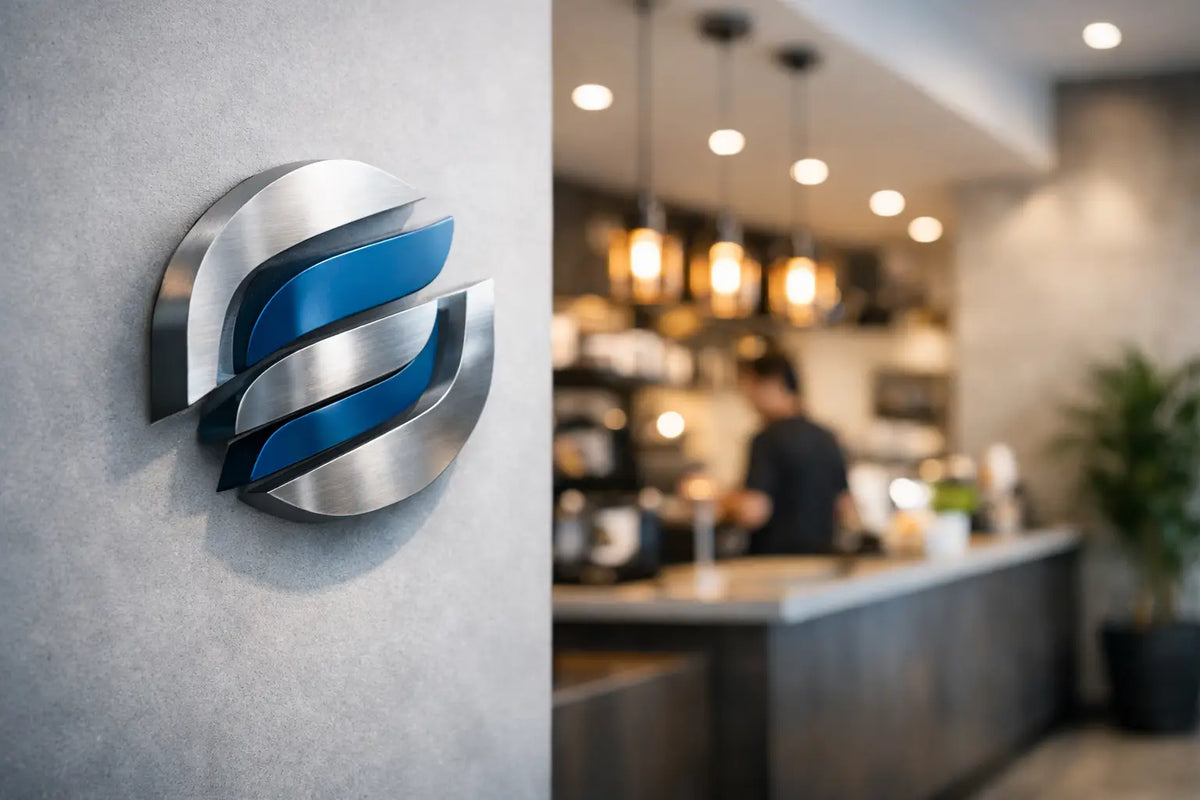
A guest walks into a cafe, salon, or showroom, and even before they look at the menu, they perceive the space with their eyes. This is precisely where the advantages of a 3D logo in a business premises become fully apparent. A logo protruding from the wall does not act like an ordinary sign. It gives the brand shape, depth, and a place in space that the customer notices within seconds.
A business doesn't have to be large to be striking. A well-designed 3D logo can transform an ordinary wall into a dominant interior feature, foster trust in the brand, and give people a clear reason to stop, look, or pull out their phone. It's not just an extra decoration. It's part of the first impression that determines whether your business will stick in their mind.
3D logo gives the brand a real presence
A flat logo informs. A three-dimensional logo communicates much more - material, confidence, style, and attention to detail. The shadow, relief, and play of light create an effect that cannot be replicated by ordinary wall printing or a sticker.
This is especially important in businesses where customers choose based on atmosphere. In a beauty salon, a 3D logo can appear clean, delicate, and premium. In a barber shop, a stronger contrast, dark background, or metallic look might be more suitable. In a bistro, it can be a natural part of the color concept, and in a company reception, it can reinforce a professional impression immediately upon a visitor's arrival.
A logo is not just a mark in a brand manual. In a business premises, it transforms into an object that people perceive from various angles and distances. This physical presence helps build memorability.
Advantages of a 3D logo in a business for customer experience
A strong visual identity makes it easier for customers to navigate. If the logo is placed behind the reception, above the bar, or at the entrance, it immediately indicates where your space begins and where attention should be directed. In larger establishments, it can also help separate individual zones – for example, a waiting area, a serving counter, a photo booth, or a VIP section.
But emotions play an even greater role. People don't remember every menu, every price list, or every product on the shelf. They remember how they felt in the place. An illuminated or precisely sculpted logo can give a space energy, tranquility, playfulness, or a luxurious character. When the visual meets your style of service and offerings, an experience that feels complete is created.
This also has a concrete impact on sharing. An aesthetic interior naturally appears in customer photos, short videos, and posts tagging your establishment. It's not about forcing guests to advertise. It's about creating a place that invites a photo on its own. A prominent logo behind an armchair in a salon, by a mirror, on a cafe wall, or backstage in a studio is a very powerful element for such content.
Light highlights shape and atmosphere
A 3D logo can function purely by its material, but combined with light, it gains another dimension. Backlighting creates a soft glow around the letters, separating the logo from the wall. Front lighting, on the other hand, highlights its color and details. For some concepts, it makes sense to combine a dimensional logo with an LED neon element, which gives the brand a unique signature.
The choice of lighting should be based on what the customer should feel. Warmer white is suitable where you want to promote coziness, hospitality, or premium materials. A neutral to cooler shade often works in modern studios, technical services, and clean, minimalist interiors. Colored light has great power but requires discipline. If the space is already full of colors, overly bright backlighting can be distracting.
Intensity is also important. The goal is not to over-illuminate the interior, but to give the logo a legible role even in the evening or in a darker part of the space. A well-designed illuminated logo will attract the eye without dazzling guests or complicating staff work.
Material determines what your brand says
Acrylic, PVC, metallic look, wood, or a combination with UV printing - each material tells a different story. That's why it's not worth choosing solely based on the unit price. The logo is visible for a long time and should naturally tie into your interior, target group, and service price level.
Matte black 3D lettering on a light wall can look architectural and clean. Glossy acrylic, on the other hand, will bring energy and a striking color. Wood works well in cafes, flower shops, or brands that emphasize craftsmanship and naturalness. For a modern clinic or office, a combination of subtle relief, precise cutting, and gentle backlighting is often suitable.
Consider the practical side as well. In gastronomy, fitness centers, or busy retail, surfaces that are easy to clean and maintain their appearance long-term are suitable. Delicate textures can look great, but in an environment with higher dust or grease, they will require more care. The right choice is always a balance between effect and everyday functionality.
Where to place a 3D logo so it doesn't get lost
The most common choice is the wall behind the reception or cash register. This makes sense, as this is where the first contact and payment occur. However, it doesn't mean it's the only correct position. Sometimes, a logo visible from the storefront, through the entrance, or in a place where the customer naturally takes photos can provide greater benefit.
Before production, it's good to check the sight lines. Stand at the door, sit at a table, walk the customer's path to the main point of the business. You'll find out where the logo will truly be legible and whether a hanging light fixture, plant, shelf, or open door will obstruct it.
Size is just as important as placement. A logo that's too small will get lost on a large wall, while one that's too large can visually shrink the space. Leave plenty of free space around it. An empty area is not wasted space – it's a frame that makes the brand stand out.
From design to implementation: details that save time and money
The best result isn't achieved by sending a logo file and choosing the first available size. Already during the design phase, it helps to know a photo of the wall, its dimensions, color, material, and the distance from which people will view the logo. For the illuminated version, it's also necessary to consider the power supply and how the wiring will be concealed.
Ideally, prepare your logo in vector format. If you don't have it, a high-quality base can often be used, but adjustments before production will be necessary. Thin lines, small gaps between letters, or very fine details may require simplification for a dimensional solution. This is not a compromise on design – it's a way to ensure the logo remains legible and accurate even from a distance.
It's worth requesting a visualization directly onto a photo of the interior. Only then will you see whether backlighting, a different color, or a slightly larger format works better. For custom production by AtmoSvetla, this step also makes sense because the design and consultation help combine aesthetics with real installation conditions.
When a 3D logo may not be the best choice
A three-dimensional logo isn't automatically right for every space. If you have an extremely small wall, a very low budget, or a temporary pop-up project for a few days, a simpler graphic solution might be more practical. In some interiors, a single striking illuminated slogan might also win out over a large corporate logo.
The purpose is decisive. Do you want to increase credibility at the reception, be more visible from the street, create a photogenic spot, or unify the interior with new branding? Each goal can lead to a different combination of size, material, and light. Good execution doesn't start with the question "how much does a logo cost," but "what should it do in this space."
Next time you stand before an empty wall in your business, don't just see it as a surface to fill. See it as an opportunity to give your brand light, shape, and an atmosphere that customers will carry with them long after they leave.