

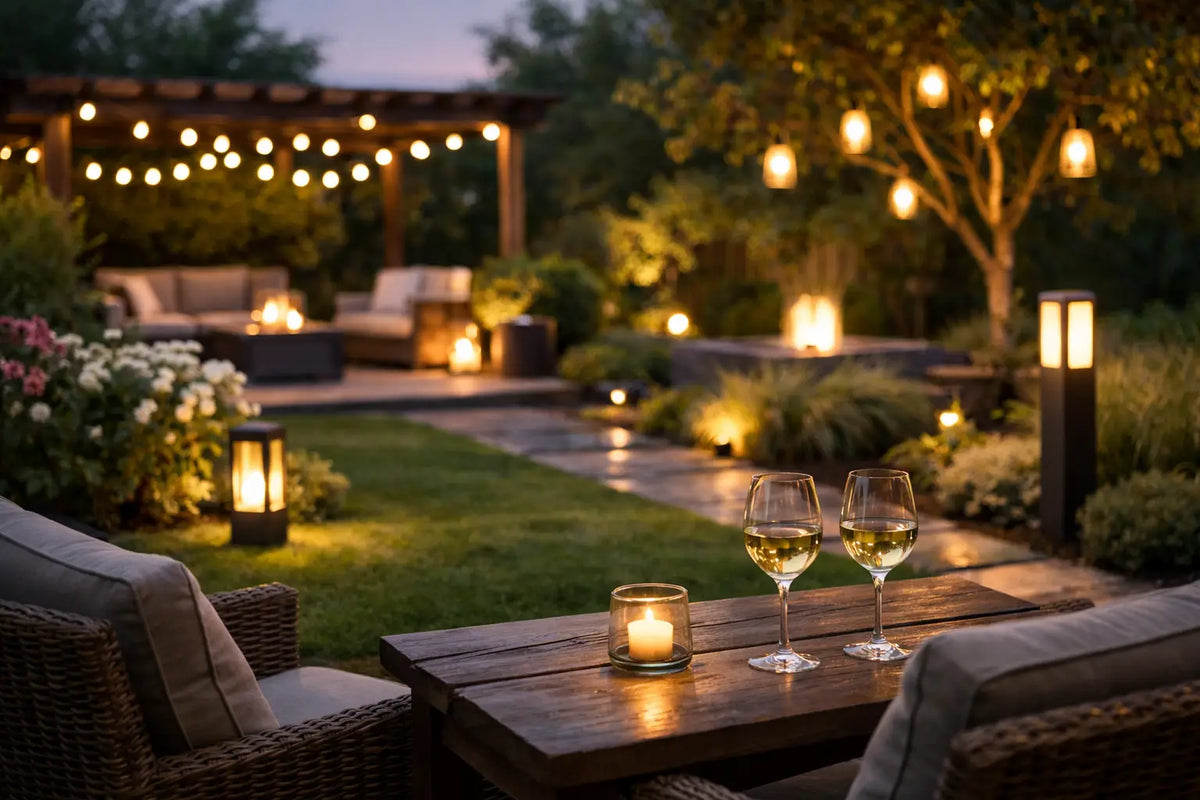
An evening on the terrace doesn't have to end when the last ray of sun disappears. Well-designed garden lighting will extend your time outdoors, highlight the architecture of your house, make it easier to move around your property, and transform an ordinary garden into a place you'll want to return to. It's not about installing as many lights as possible. The result depends on contrast, the correct direction of light, and a thoughtful atmosphere.
Outdoors, the difference between "some light" and light that truly works is immediately apparent. One unpleasantly sharp lamp can spoil the entire view of the garden. Conversely, a few subtle light points can add depth, safety, and a distinctive style to the space.
Start with what you want the light to do in the evening
First, walk through the garden after dark.
Where do you automatically slow down?
Where do you look for keys, a step, or the path to the pergola?
And what, on the other hand, do you want to see from your living room window?
Your answers will divide the space into functional and decorative zones.
The entrance, gate, driveway, stairs, and main pathways need security. The light here should not be dazzling, but clearly show the direction and any unevenness. The terrace, pergola, or outdoor kitchen require comfort for dining and conversation. Flowerbeds, solitary trees, a stone wall, or a pond then function as evening scenery – they don't need strong illumination, they need the right accent.
A common mistake is trying to illuminate the entire property evenly. The garden then appears flat, cold, and less cozy than during the day.
Darkness is not the enemy. It is the background that makes thoughtfully lit lines, structures, and dominant features stand out.
Layered garden lighting works best
Just like indoors, the exterior also has its layers of light. The base consists of orientation lighting for paths and entrances. The second layer is practical light by doors, on the terrace, or under the pergola. The third layer is purely emotional: light in the grass, under tree canopies, among planters, or around a prominent garden feature.
Paths and stairs: less power, more direction
For paths, low post lights, recessed spotlights, or wall-mounted lights that direct light downwards work well. Adjust the spacing to the width of the path and the height of the fixture. Too dense a layout creates an airport runway effect, while too sparse a layout fails to fulfill the safety function.
For stairs, choose side or bottom lighting for individual steps. The light source should not aim into the eyes of a person going up. If the staircase is near the house, a discreet light integrated into the wall or under the edge of the step is often an elegant and clean solution.
Terrace and pergola: create light for people
A central ceiling light above the table is practical, but on its own, it often appears harsh. Complement it with perimeter lighting: wall-mounted lights, portable lamps, or subtle LED points. This prevents a sharp circle of brightness in the center with black emptiness around it.
For evening dining, warmer light is usually more pleasant. You can see the food and faces, but the space doesn't lose its calm atmosphere. A wireless table lamp is also a quick way to change the atmosphere without cutting cables – it's suitable for a table, a sun lounger, or a garden party.
Trees, flowerbeds, and walls: light as scenography
Lighting a tree from the ground highlights the texture of the trunk and crown, while subtle light hidden in a flowerbed adds depth to the planting. For prominent grasses, sculptures, or stones, work with one precise point rather than several strong sources. Test the direction of the light before final installation – a difference of a few tens of centimeters often determines whether the result will look designed or random.
Light on the facade can highlight the house material, but don't overdo it. If the house is modern and clean, a few precisely chosen wall lights often suit it better than general illumination of the entire wall.
Light temperature determines the mood
The color of light is expressed in Kelvin and has a greater impact in the garden than it might seem at first glance. Warm white light around 2200 to 3000 K resembles an evening sun or a candle flame. It is suitable for terraces, pergolas, relaxation corners, and for illuminating greenery. Leaves, wood, and stone look more natural and pleasant in it.
Neutral light around 4000 K can make sense for technical areas, such as the garage, service entrance, or the back of the property. In a living area, however, it can appear too cold. Mixing colors is not forbidden, it just needs a clear reason: keep a warm atmosphere for places where you live, and neutral functional light for places where you need to see what you're doing.
Colored RGB lighting can be a great effect for a celebration, a bar, or a striking modern corner. But for an everyday garden, it's better if it looks good even without a color program. The design should work on a Monday evening as well as at a summer party.
Outdoor safety starts with IP rating
An outdoor light fixture must be able to withstand rain, dust, temperature changes, and morning humidity. Therefore, pay attention to the IP protection rating. For general outdoor use on a facade or under a partially protected pergola, at least IP44 is often chosen. Luminaires placed freely in the garden, at ground level, or where rain falls fully on them, usually require higher protection, typically IP65 and above.
However, do not confuse the fixture's protection with safe installation. If you plan permanently wired garden lighting, underground wiring, or lighting near water, leave the design and installation to a qualified electrician. It will save you worries about safety, moisture, and future maintenance.
It is practical to divide circuits separately for the terrace, pathways, and decorative elements. This way, you don't have to light up the entire property every time you just go to the garden shed.
Solar, wired, or wireless lighting?
Solar
Quick, affordable, no cables. However, performance depends on how much sun they actually get during the day – weaker results in shade or autumn.
Wired
The greatest certainty of performance, long lifespan, and stable appearance. Requires planning before garden landscaping.
Wireless
Do not change the electrical installation, but provide higher quality light and flexibility. Ideal if you want to change the atmosphere according to the evening's program.
Smart control is not just a fancy accessory
A dusk sensor ensures that orientation lights turn on at the right time. A motion sensor is useful at entrances, gates, garages, or technical areas. On a terrace, however, it can be unpleasant if the light reacts to every wave of a hand and unnecessarily disturbs the peace.
Control via an app, remote control, or separate zones primarily brings convenience. You can have one mode for returning home, another for visitors, and a third for a quiet evening for two. Light thus does not become a fixed backdrop, but an active part of the space.
Let the garden breathe even after dark
Quality garden lighting is not a competition in the number of lumens. It's a thoughtful approach to where you want to lead people, where they should feel safe, and what they should admire in the evening. Start with one zone that you use most often, and gradually add more layers.
If you want to transform your terrace or outdoor corner into a distinctive design experience, AtmoSvetla will help you find light that not only illuminates but also creates your own atmosphere.