

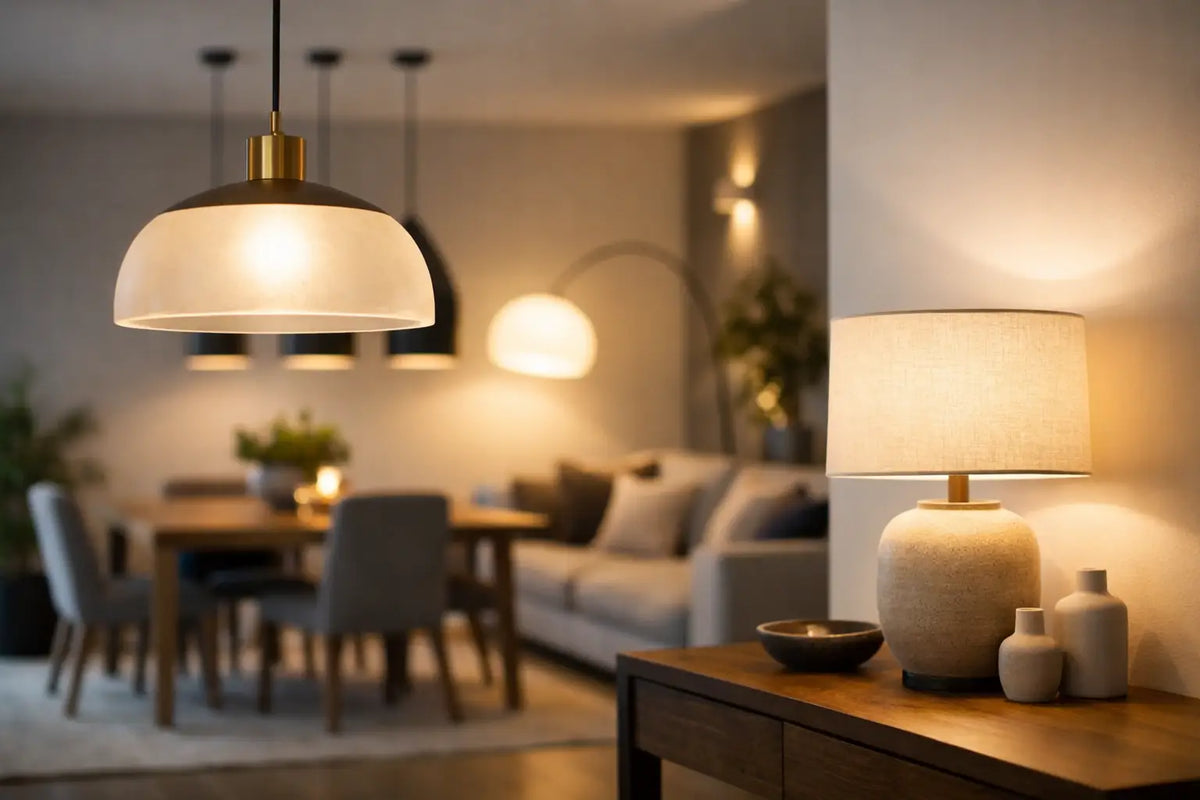
An empty room often doesn't look bad because of the furniture, but because of the light. A single strong ceiling source does the job, but it won't create an atmosphere. If you are trying to figure out how to coordinate interior lighting, don't start by choosing a lamp based on a photo in an e-shop, but by how the room is meant to function in the morning, in the evening, and in those moments when you just want to feel good in it.
In an interior, light is more than a technical detail. It determines whether a living room feels cozy, a kitchen feels clean, and a bedroom feels calm. And that is precisely why it pays to think of it as a design layer that combines aesthetics, comfort, and everyday operation.
How to coordinate interior lighting according to room function
The most common mistake is simple – there is one central light fixture in every room, and that is where the plan ends. In reality, however, one lamp cannot do it all. You need a different intensity for cooking, another for reading, and a completely different one when you want to slow down in the evening.
In the living room, a combination of main light, auxiliary lamps, and accent lighting works best. A ceiling fixture provides the foundation for the space, a floor or table lamp adds comfort, and a smaller decorative light highlights a shelf, a picture, or a distinct detail. It is here that it becomes clear that a coordinated interior is not created by a single source, but by their cooperation.
In the kitchen, precision is more important. A central light alone is not enough, as the worktop often remains in the shade. It makes sense to have bright lighting for the workspace, while the light above the dining table can be softer and visually more prominent. This way, the kitchen doesn't feel like a laboratory, yet remains practical.
The bedroom can handle less contrast and more peace. The goal there is usually not maximum output, but a pleasant lighting composition. Wall lights or bedside lamps, a softer ceiling light, and perhaps a subtle ambient element do more than one harsh chandelier in the middle.
In the bathroom, details matter. Light by the mirror should be as natural as possible so as not to distort skin tone or colors. At the same time, you don't want the whole bathroom to feel harsh and impersonal. Here, too, it helps to divide the light into functional and atmospheric parts.
Style is not enough. Color temperature and intensity also decide
Even if the light fixtures match in terms of design, you haven't won yet. The second half of success is the color of the light and its strength. This is often where the impression of a space is made or broken.
Warm light feels soft, homey, and relaxed. It fits into the living room, bedroom, or anywhere you want to induce a calmer atmosphere. Neutral light is usually more versatile and works well in the kitchen, study, or bathroom. A colder shade can support concentration and a clean visual impression, but it pays to be careful with it in a home interior. When there is too much of it, the space loses its coziness.
Intensity is equally important. Light that is too weak tires the eyes and flattens the room. Light that is too strong creates an uncompromising atmosphere in which it is hard to switch off. It is ideal if you have the option to change light levels according to the time of day and your mood. Dimming is not an extra luxury, but one of the most practical ways to get the most out of an interior.
Light layering is a foundation, not a design bonus
Anyone who wants to know how to coordinate interior lighting so that it looks well-thought-out should adopt one principle – layering. It may sound professional, but in practice, it follows simple logic.
The first layer is general lighting, i.e., the one that lights up the room as a whole. The second layer is task or functional light. This includes a reading lamp, kitchen unit lighting, or a light over a table. The third layer is mood and accent lighting. This does not address output, but atmosphere. It can highlight a wall's texture, an open shelf, a decor item, or perhaps a neon element that becomes the identity of the space.
The third layer is often what decides whether an interior feels ordinary or has character. And this is not just for homes. In a café, salon, or studio, accent light is what people remember, photograph, and associate with your brand.
How to coordinate fixtures with each other so they don't look random
Coordinating lighting does not mean buying everything from one series. That is a common mistake. The interior can then feel too uniform, almost like a showroom without personality. It is much better to stick to a shared visual direction.
It helps to repeat materials, shapes, or colors. If you have black metal details in the space, they can gently echo in a floor lamp, a wall light, and a pendant fixture. If the interior is softer and more natural, glass, textile, or organic forms work well. The important thing is for the elements to conduct one visual conversation, rather than drowning each other out.
The same applies to bold designer light fixtures. One statement light can be a great move. Two to three striking focal points in one room, however, are often fighting for attention. When one element is strong, the others should act more as a support for the whole.
Mistakes that keep a space from ever shining
Some interiors have nice furniture, quality materials, and good colors, yet they still don't feel right. The reason is often in the lighting plan.
A common mistake is having light only in the center of the ceiling. Another is the combination of different light temperatures in one room without a clear intent. It also feels unpleasant when the dining table is poorly lit, while a corner of the room is illuminated too harshly. And underestimating decorative light is a separate chapter. The interior functions, but it doesn't radiate anything extra.
There is often a problem with scale, too. A small lamp gets lost in a spacious living room, while a massive pendant light can feel heavy in a low room. The size of the fixture must correspond to the space and the furniture around it. This is not a detail, but a basic proportion.
Atmosphere is no accident. It arises from contrast and intent
The most interesting interiors are not the brightest ones. They are those where light works with depth. Instead of uniform lighting from wall to wall, it is often much more impressive to let some zones gently recede and highlight others.
This applies especially in the evening. During the day, the room carries natural light; in the evening, artificial lighting takes over, and suddenly every poor choice is visible. That is why it makes sense to think in terms of scenes. One for daily operation, a second for guests, a third for a quiet evening. The interior is then not static, but responds to the life within it.
And if you want to bring more personality into a space, light can do it without a major structural change. A bold wall lamp, a wireless lamp on a dresser, or a neon detail can transform the mood of the whole room in a moment. Not as an extra fancy accessory, but as part of the identity of the space.
When it makes sense to opt for a decorative or custom solution
Not every interior needs a custom element. But if you have a specific vision, an unusual layout, or want to create a truly memorable detail, serial solutions may not be enough. This applies both at home and in business.
In a home, it might be a light element over a bar, in a work corner, or in a child's room. In a commercial space, the role is even stronger – light there does not just fulfill a function, but supports the brand, orientation, and impression of the space. A well-designed neon or light sign is not just decoration. It is a visual signature.
It is here that custom production makes the most sense. When light corresponds to the space, style, and goal, it doesn't feel like an added layer, but as a natural part of the whole. And that is exactly the difference between an interior that is just furnished and an interior that has an atmosphere.
How to start if you don't want to make a misstep
You don't have to redraw the whole apartment right away. Start by answering three questions for each room: what happens here, when does it happen, and how do you want to feel here? It sounds simple, but it is from these answers that a functional lighting plan is created.
Then look at what the room is missing. In some places, it is softer evening light, elsewhere it is workspace lighting, and in others it is an element that gives the space character. Only then choose specific light fixtures. Not based on what is currently trendy, but on what will truly light up the atmosphere in your interior.
When light is coordinated well, the room suddenly starts to function differently. It looks more confident, feels more pleasant, and is a better place to live and work. And that is exactly the point – not to just have the lights on, but to have light that gives a place meaning.