

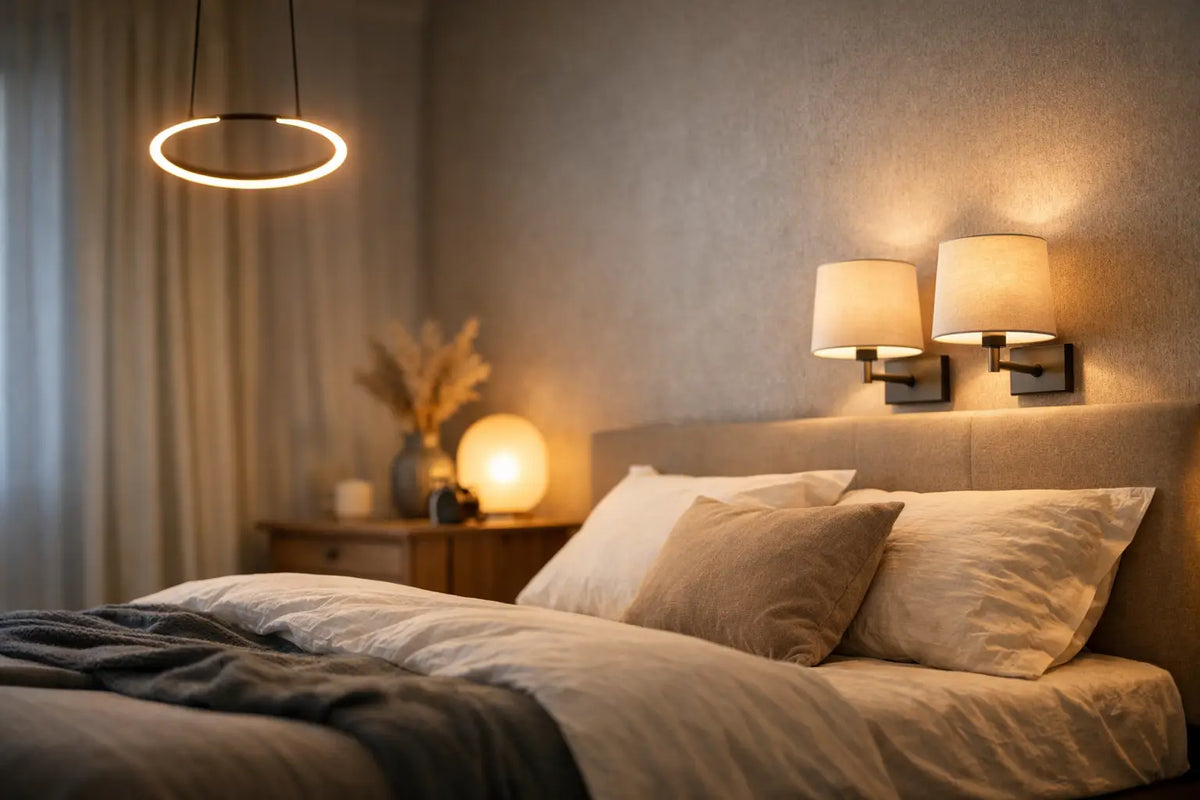
A bedroom is not a showroom or an office. It is a place where light should not push for performance, but rather work for peace, comfort, and the rhythm of the day. That's why the question of what lighting to choose for the bedroom is not just about the appearance of the fixture. It's about how you want to feel in the space in the evening before bed, in the morning after waking up, and during the day.
Many people make the same mistake. They put one strong light in the middle of the ceiling, which "illuminates everything" but tends to kill the atmosphere. The bedroom then feels flat, harsh, and impersonal. Yet, layering light works better here than in any other room.
What Lighting Works in a Bedroom in Practice
The best result is usually not achieved with a single light fixture, but with a combination of several sources. A bedroom has multiple roles. It serves for sleeping, reading, changing clothes, sometimes even for working or applying makeup. Each of these activities requires a different type of light.
The base is formed by central lighting, which opens up the room and gives it a clear brightness. However, it should not be aggressive. Ceiling lights with diffused light that do not create harsh shadows and do not appear cold are ideal. If you have a lower ceiling, surface-mounted variants work well. In a higher bedroom, you can even afford a pendant light, but always so that it does not appear heavy.
The second layer is mood lighting. This is where the bedroom transforms from a regular room into a space with character. This can be wall lamps, subtle LED backlighting behind the headboard, a floor lamp in the corner, or a smaller decorative light on a dresser. This light does not have to dominate in terms of power. Its purpose is to create a soft transition between an active day and a peaceful evening.
The third layer is functional lighting, typically reading lamps. These should illuminate exactly where you need them, without dazzling your partner next to you. Wall lamps with a swivel arm or table lamps with a warmer but still sufficiently strong light work excellently.
Light Temperature Matters More Than Design
When deciding what lighting to choose for the bedroom, most attention falls on the shape, color, and material of the fixture. However, how the space truly feels is largely determined by the color temperature.
Warm white light is most suitable for a bedroom. It feels soft, calming, and promotes a relaxing atmosphere. Colder shades, which are suitable for a study or utility room, usually seem out of place here. While they can provide energy in the morning, they tend to be too sharp and disruptive in the evening.
This does not mean that the bedroom must necessarily be dark. Rather, it should be pleasant for the eyes. If you want more flexibility, it's worth choosing a dimmable solution. With one touch, you can set a brighter mode for cleaning or dressing, and in the evening, you can dim the space to a softer, calmer setting.
The ability to adjust is often more important than chasing the strongest possible bulb. Strong light in itself is not a win if you don't feel comfortable in it.
Ceiling Light Yes, But Not Alone
A central fixture has its place in the bedroom. Without it, it's difficult to maintain comfort during everyday activities. The problem arises when it's the only light in the room.
One ceiling light usually creates a flat effect. Everything is visible, but nothing stands out. There is a lack of depth, softness, and a feeling of coziness. If you want a bedroom that feels thoughtful and not just "furnished," you need to distribute the light across multiple points.
A simple rule works well. Use the ceiling light as a base, but let side and accent lighting create the atmosphere. The room then doesn't feel over-lit and also gains visual layers. This is precisely the difference between a bedroom where you just sleep, and a bedroom you look forward to.
Bedside Lamps: The Detail That Creates Comfort
Bedside lamps are often underestimated, yet they are one of the most used light sources in the entire bedroom. Not only the appearance matters, but also the placement, height, and method of illumination.
If you read in bed, you need directional light. If you mostly want a soft evening atmosphere, a more diffused lamp with a soft glow will suffice. Some prefer table lamps on bedside tables, while others appreciate wall-mounted variants that save space and look cleaner. In a smaller bedroom, this is often a more practical solution.
Symmetry is also important, but not at all costs. Two identical lamps look elegant, but if each partner has different lighting needs, it's worth thinking individually. Design should serve you, not the other way around.
When the Bedroom Also Has a Wardrobe Area or Dressing Table
Modern bedrooms often serve more than just sleeping. They can be connected to a wardrobe, open storage, or a dressing corner. And that's when a lighting plan needs to be a little more precise.
Near a wardrobe, you want to see the true colors of clothes, not just a soft outline. Here, a slightly more neutral and targeted light might make sense than what you'd choose for the relaxation part of the room. By the mirror, it's crucial that the light doesn't create harsh shadows on the face.
It's perfectly fine if one part of the bedroom has a more practical character and the other is purely relaxing. That's the power of well-designed lighting - the space doesn't have to be lit uniformly everywhere to function as a whole.
Materials and Style: Light Must Suit the Interior
A bedroom is a very personal space, so the choice of lighting should follow the materials, colors, and overall mood of the interior. In a minimalist bedroom, simple lines, matte finishes, and subtle shapes work perfectly. In a softer, cozier style, textile shades, warm metals, or frosted glass stand out.
If you want to give the space a more distinctive identity, don't be afraid of decorative lighting. A subtle light accent can differentiate a bedroom much more elegantly than another shelf or decoration. When used thoughtfully, it creates a signature for the space without unnecessary clutter. This is precisely the approach of brands that perceive light not just as technology, but as an atmosphere.
But beware of the opposite extreme. A distinctive designer light fixture can be beautiful, but it must not overshadow its function. A bedroom is not a gallery of objects. If the light looks great but dazzles or is impractical, it will annoy you in the long run.
Common Mistakes When Choosing Bedroom Lighting
The first mistake is too cold light. The second is only one central light fixture. And the third is often underestimating the intensity of reading lamps. The result is either an uncozy space, or a beautiful but impractical bedroom.
It's also common for lights to be chosen separately, without considering the whole. A ceiling lamp, a different bedside lamp, another decorative piece - each works on its own, but together they visually clash. Yet, a bedroom benefits from a more unified approach than, say, a living room.
Another misstep is ignoring the size of the room. In a large bedroom, overly subtle light will get lost, while a robust chandelier will be excessively dominant in a small one. Scale plays a big role and often determines whether the space feels balanced.
How to Choose Lighting Based on What You Expect from Your Bedroom
If you primarily want peace and a soft atmosphere, opt for warm tones, multiple smaller sources, and dimming capability. If your bedroom also serves as a practical morning base, you need stronger basic lighting and well-designed lighting by the wardrobe or mirror.
For a smaller apartment, the bedroom can be multi-functional, and then it makes sense to combine aesthetics with performance. Conversely, in a spacious bedroom, you can afford to work more with mood, lighting zones, and decorative accents. There is no one-size-fits-all solution. But there is a correctly chosen combination for your way of living.
If you want your bedroom to look modern yet retain warmth, it's worth thinking about light as part of the interior concept, not as the last "end of the line" purchase. That's when a space emerges that is functional by day and beautiful by night.
With well-chosen light, you don't just notice that you can see. You primarily notice that you slow down better, rest better in the bedroom, and the entire space finally shines as it should.