

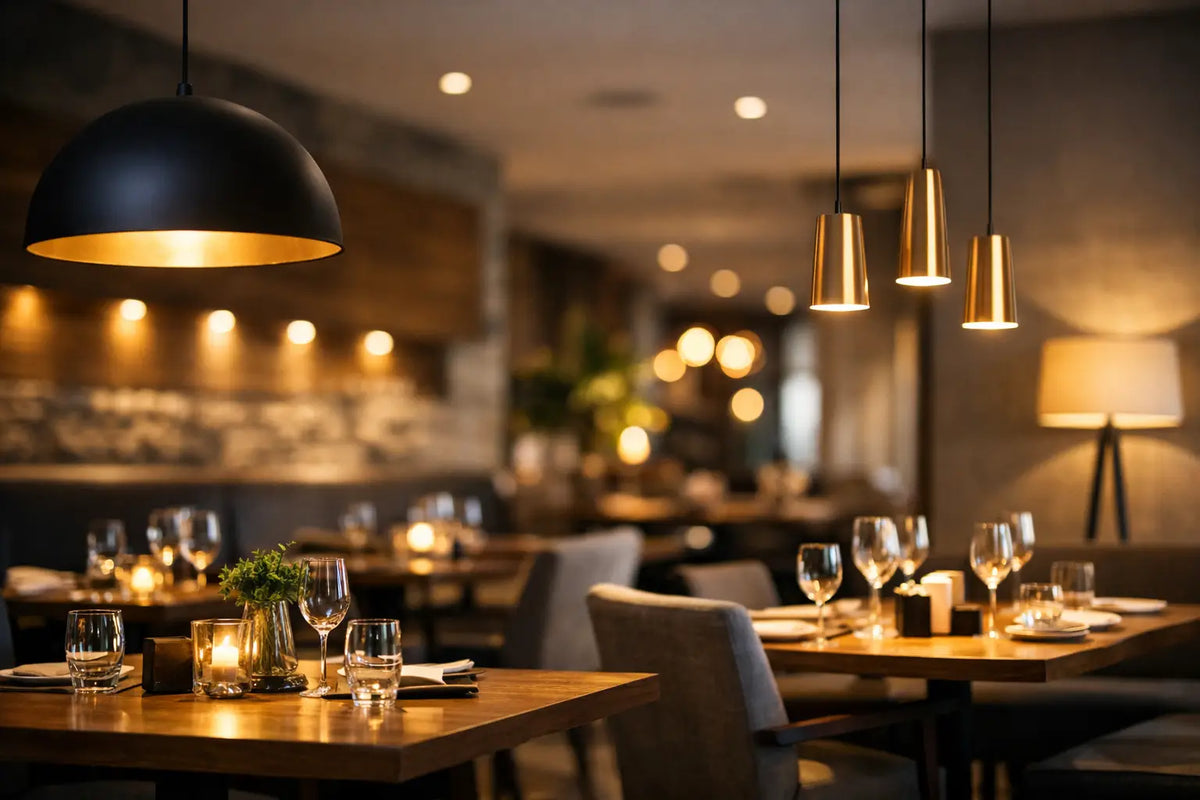
The guest sits down at the table, hasn't even opened the menu yet, but already knows if they want to stay. That's precisely why the question of how to light a restaurant stylishly is much more than just choosing nice lamps. Light determines the first impression, how the food stands out, how the interior looks in photos, and whether guests will order dessert and a second drink.
In a restaurant, you're not just selling a menu. You're selling an atmosphere, the pace of the evening, and a feeling that makes people come back. When the light is too harsh, the space feels cheap and impersonal. When it's too dark, guests don't feel comfortable, staff struggle to function, and the food loses its visual appeal. Stylish lighting is therefore always a balance between design, practicality, and brand character.
How to light a restaurant stylishly without making unnecessary mistakes
The most common mistake is simple - one central layer of light and done. That's how a warehouse works, not a business that's supposed to have its own character. A stylish restaurant works with multiple layers: basic lighting for orientation, accent lighting for tables and details, and mood lighting that maintains the atmosphere of the space.
Basic light should not draw attention to itself. Its task is to create a clean, pleasant framework in which both guests and staff can move around comfortably. Ceiling lights, track systems, or recessed spots bring order to the space, but they don't create style on their own. That comes when you add the second and third layers.
Pendant lights, wall lamps, or subtle spot lighting work well above tables. This is where intimacy is created. Guests want to see each other and what's on their plate, but they don't want to sit under light that reminds them of an office. Well-adjusted light above the table turns an ordinary seating arrangement into a scene with depth and mood.
And then there's the decorative layer. A neon sign, a backlit logo, a lighting detail on the wall, or a subtly lit bar. These are elements that differentiate a restaurant. They are not just pretty. They are memorable, photogenic, and commercially strong.
The atmosphere must match the concept
A fine dining establishment needs a different lighting signature than a modern bistro or a burger joint aimed at a young audience. Stylish lighting is not a universal recipe. It always stems from how you want guests to feel and how long they should stay in the space.
In an elegant restaurant, warmer, softer, and calmer light works well. The space then appears sophisticated, the food looks more appetizing, and the whole evening has a slower, more luxurious rhythm. Conversely, in a bistro or fast-casual operation, the light can be a bit livelier, more contrasting, and more energetic. It supports speed, freshness, and an urban character.
If you have an industrial interior, you don't automatically have to opt for cold light. That's a common shortcut. Metal, concrete, and dark tones often stand out better with warm or neutral lighting that softens them and makes the space more inviting. Style isn't created by copying a trend, but by light that suits your concept.
Light temperature matters more than most businesses admit
When a restaurant feels unpleasant, the problem is often in the color of the light, not the furniture. Too cool tones can kill even a well-designed interior. Guests' skin looks tired, food loses its color, and the space has an impersonal expression.
In most restaurants, warm to neutral-warm light works best. It adds depth to the interior, gives wood and textiles a pleasant look, and gives food the right visual tone. However, this doesn't mean everything has to be yellow and dim. In service areas, the bar, or an open kitchen, it's often appropriate to add cleaner and brighter light to aid operations.
This is where style and function must work together. The guest perceives the atmosphere, the staff needs to see. A good solution therefore often combines pleasant light in the customer area and more practical lighting where work is done quickly and precisely.
Light above the table is a small thing with a big impact
If there's one place where the impression of a restaurant is decided, it's the table. Food, conversation, and social media photos meet above it. If the table is shrouded in darkness, guests don't feel cozy, but uncertain. If it's overexposed, intimacy is lost.
Stylish table lighting should be focused, pleasant, and visually clean. A pendant light can create a beautiful zone, but it must be at the right height and with appropriate intensity. Too low, it will obstruct the view; too high, it will lose its effect. For smaller tables, a softer cone of light works well; for larger ones, it's better to spread the light so that no one sits outside the main zone.
What the light does to surfaces is also important. Glossy tops, glass, or metal can create unpleasant reflections. Matt materials, on the other hand, carry light more elegantly. That's why it's good to address lighting and restaurant furnishing simultaneously, not separately.
The bar, entrance, and logo should attract attention
When thinking about how to light a restaurant stylishly, don't just start with the tables. Places that form the first and last impression have great power. The entrance, bar, and visual identity of the establishment deserve their own lighting scenario.
The entrance should naturally draw the guest inside. If it's dark from the outside or visually disappears, you lose the attention of passersby. A well-lit logo, a light-up sign, or a distinctive decorative element can do exactly what good branding should do - be recognizable in a second.
The bar is usually the natural center of the space. When you subtly highlight it, the restaurant gains drive and energy. It doesn't have to be the brightest, but it should be legible and visually appealing. For modern establishments, backlit shelves, accent lighting on bottles, or a neon detail that gives the space its own signature work wonderfully.
This is where it also makes commercial sense to think. Lighting branding is not just decoration. It's an element that supports the memorability of the establishment, guest photos, and the overall identity of the place. If you want people to associate your space with a specific atmosphere, light will do it faster than most other elements.
Stylish lighting must work day and night
One of the toughest disciplines is a restaurant that operates from lunch to evening seating. During the day, you need more freshness and legibility. In the evening, you want to soften, slow down, and create a more intimate mood. If the lighting concept only accounts for one mode, it will appear wrong during part of the day.
The solution is often dimming and a thoughtful division of individual circuits. In the morning and at lunchtime, the basic light can be more active; in the evening, accents and mood layers are strengthened. This way, the space doesn't lose functionality, but can also transform according to the time of day.
This is precisely the detail that a guest often unconsciously appreciates. They don't feel that the restaurant is just lit. They feel that it works.
What to consider even before buying lighting fixtures
A beautiful light fixture alone won't guarantee success. First, you need to know what each place in the establishment is supposed to do. A shop window has a different role, a lounge a different one, toilets another, and a terrace yet another. Each zone needs its own intensity, character, and degree of decorativeness.
It's also worth addressing maintenance, durability, and real-world operation. A restaurant is not a showroom. Lights must be able to handle the daily pace, easy cleaning, and consistent long-term performance. Design without practicality quickly ages, just like a technical solution without atmosphere.
If you want light to truly sell the space, don't choose it as the last item in the budget. Treat it as part of the establishment's identity. That's its true strength. Whether you're working with subtle elegance or want a striking lighting statement, a good solution doesn't happen by chance. It happens when you know how your restaurant should feel - and then you let that feeling literally shine.
When the lighting is successful, guests may not say it out loud. They'll just stay longer, come back, and remember your space exactly as you need them to.