

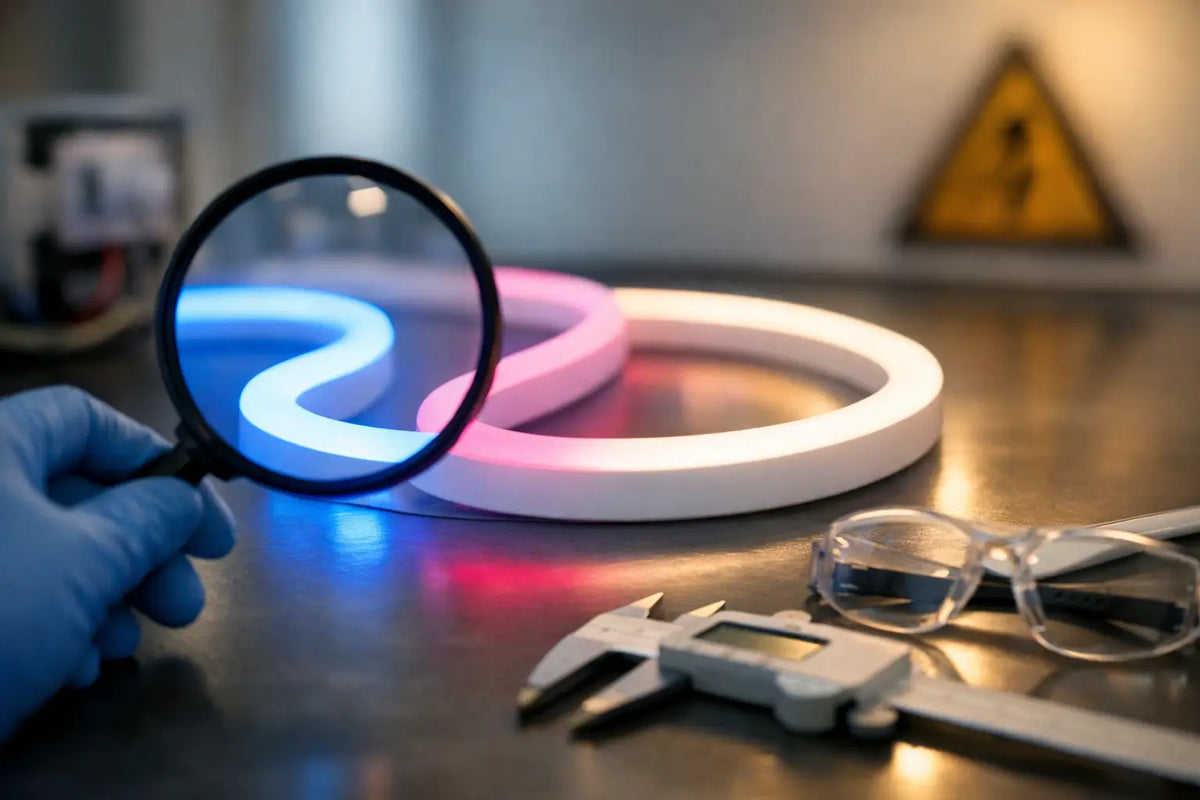
Just because a light sign looks great in photos doesn't mean it's suitable for above a bed, in a child's room, or in a busy establishment. The question, "Is LED neon safe?", is one of the smartest to ask before purchasing. And the answer is good news – in most cases, yes, if it is properly designed, well-made, and connected correctly.
LED neon has gained popularity because it offers a striking visual effect without the drawbacks of classic glass neon. It is not fragile, consumes less power, and in normal operation, it doesn't heat up enough to be a hazard in a home or commercial space. However, as with any lighting, safety is not solely determined by the fact that it uses LEDs. Construction, power supply, placement, and usage all play a role.
Is LED neon safe for everyday use?
For most homes, studios, shops, cafes, and receptions, LED neon is a safe solution. The light is generated by LED diodes housed in a flexible casing, most often made of silicone or PVC, which eliminates the need to work with thin glass and gas under voltage, as with traditional neon. This is a fundamental difference not only for design but also for everyday operation.
In practice, this means a lower risk of breakage, a lower operating temperature, and easier handling. When someone buys a light sign for their bedroom, beauty salon, or above a bar, they often focus mainly on the appearance. However, it is precisely the safer material and modern power supply that are the reasons why LED neon has become so popular even in places where children, customers, or staff are present all day.
But that doesn't mean that every product on the market is automatically risk-free. Cheap products without clear parameters, with a weak adapter, or poor craftsmanship can have a shorter lifespan and worse durability. For a lighting element that is meant to be a long-term part of the space, it pays to consider more than just the price.
What makes LED neon safe
The safety of LED neon relies on several factors simultaneously. The first is low operating voltage. Many LED neons operate via an adapter that converts mains voltage to a significantly lower and safer value. This reduces the risk compared to older technologies that operated differently and more demandingly.
The second factor is the heating itself. Although LED neon heats up when lit, it usually does so much less than classic light sources or traditional neon tubes. This is particularly important where the light is near a wall, furniture, or places people might touch. If the product is of good quality and not covered by material that prevents heat dissipation, normal operation is usually not a problem.
The third area is mechanical resistance. Flexible LED neon strips and signs on a backing plate tend to be more impact-resistant than glass variants. In a commercial space, this is a practical advantage. At home, it offers extra peace of mind if you have children, pets, or simply don't want to worry about every careless touch.
Material and craftsmanship are not just details
At first glance, two LED neons might look similar, but the difference is often inside. You can recognize quality workmanship by clean finishing, stable illumination, well-designed power supply, and materials that don't look cheap or fragile. If the neon is meant to serve as a long-term design element or corporate branding, it's more than just aesthetics. It's also a question of reliability.
A well-designed product takes into account where it will hang, how long it will light, and what its performance should be. This is the difference between an eye-catching light for a weekend event and a lighting element that is supposed to function for months or years without unnecessary complications.
Is LED neon safe for apartments and children's rooms?
Yes, often that's where it makes the most sense. People want light that creates atmosphere, doesn't feel harsh, and doesn't bring the stress of high heat or fragile glass. LED neon is therefore suitable above a bed, in a study nook, in a playroom, and as a striking decor in the living room.
For a child's room, however, it's good to consider the placement. The light sign should not hang so low that a child can pull on it, and the cabling should be safely out of reach. If the neon is securely attached and connected via the correct adapter, it's a reasonable solution. Another advantage is that the light is usually pleasant to look at and can function as a soft complement to the evening atmosphere.
It's important not to confuse decorative lighting with the main lighting for the room. LED neon creates the character of a space, but it usually doesn't replace full ceiling or task lighting. When used correctly, it adds style without unnecessary compromise on safety.
Safety in an establishment has slightly different rules
In a restaurant, bar, showroom, or salon, it's not just about whether the light looks good. It must withstand longer operation, be stable, easy to install, and suitable for the specific environment. This is where the question "Is LED neon safe?" also takes on a commercial dimension. Safe lighting isn't just peace of mind for staff and guests. It's also a lower risk of outages, damage, and unscheduled replacements.
For commercial spaces, the correct choice of placement is crucial. A different type is suitable behind reception, another in a display window, and another on a wall in a food service establishment. If the space is damp, dusty, or more heavily used, it's necessary to consider the ingress protection (IP) rating and the overall design. There is no universal answer here. Safety is always linked to the specific application.
That's why it makes sense to address the design from the start based on the space, not just a pretty picture. Lighting branding should attract attention, but also function flawlessly without stress in everyday operation.
What to watch out for before buying
If you want to be sure, don't just look at the light color or font style. Ask about the product's power supply, what it's made of, how it's installed, and for what environment it's intended. For indoor lighting, the situation is usually simpler; for outdoor or humid environments, more parameters need to be monitored.
The adapter is also important. This is often underestimated, yet it is a key component of the entire setup. A low-quality power supply can cause flickering, overheating, or shorten the lifespan. Similarly, it's not a good idea to improvise with non-original accessories if the manufacturer recommends a specific solution.
Installation also deserves attention. LED neon is not complicated to install, but it must be firmly secured and the cable must not be under tension or in a poorly protected location. In a household, this mainly means tidiness and stability. In an establishment, it also means resistance to the daily movement of people.
When to be extra careful
Caution is advised if the product seems suspiciously cheap, lacks clearly stated parameters, or if you don't know where it comes from. Similarly, if the light is to be placed outdoors, in a bathroom, in a kitchen with higher humidity, or in an area where people might frequently touch it. In such cases, it's necessary to address specific technical conditions and not rely on the assumption that every model can handle everything.
This is not scaremongering. Just a realistic perspective. LED neon is safe when it corresponds to the environment in which it will operate.
Consumption, heat, and long-term operation
One of the reasons why LED neon wins over home and business customers is its low consumption. Compared to classic neon or some older lighting solutions, operation is more economical, which makes sense especially where the light is meant to shine for long hours. Lower consumption also usually means lower stress on the entire system.
Heat is also related to this. LED neon is not cold in an absolute sense, but in normal use, it operates at more favorable temperatures. This is practical for interiors where you want a lighting effect without unpleasant radiant heat. Nevertheless, a simple rule applies – light needs space and should not be covered by textiles, paper, or other materials not intended for contact with lighting.
If the neon is to shine daily, it is worth considering the quality of manufacturing. A well-made piece will not only look better. It will function more stably, retain its color longer, and cause fewer worries after installation. This is precisely when a decoration becomes a smart investment in atmosphere and the impression of the space.
When you want effect without unnecessary risk
LED neon is not just a trendy photo accessory. It is a lighting element that can transform an apartment, studio, or brand without carrying the typical weaknesses of classic glass neons. If you pay attention to quality, correct use, and sensible installation, you get a design effect that is both practical and safe.
And that is its strength. Good light doesn't just create a glow. It creates an atmosphere that works every day – and you don't wake up feeling like you've hung an unnecessary compromise in your home or business. If you have a specific idea, it's worth having it designed so that it not only looks great but also functions flawlessly.