

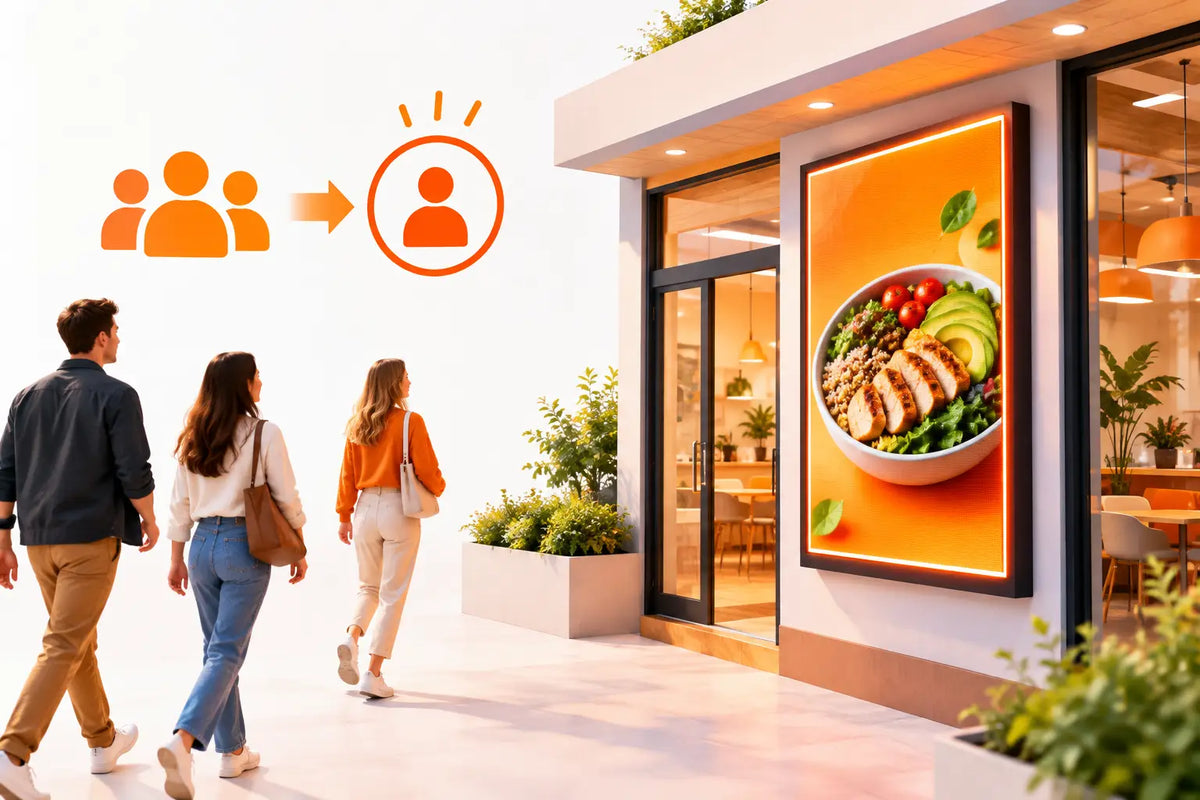
Dozens, perhaps hundreds of people walk past your shop window every day. Most of them decide within a few seconds whether to look inside or keep walking. This is exactly where well-designed LED signage comes in. It doesn't just glow. It gives your brand a face, guides the eye and creates a reason to remember your business even after people have left.
For a bistro, an illuminated sign can be the final nudge before dinner. For a salon, it is the first signal of style and care. For a shop, studio or showroom, light is part of the identity just like the logo, colours or tone of voice. If signage is to work, it must not only be visible. It must be clearly yours.
What LED signage should achieve in a few seconds
Successful signage doesn't start with the question of where to put the light. It starts with what a person should feel and do when they see it. Should they come inside? Take a photo of the space? Remember the name? Or recognise instantly that this is where they'll find a premium service, speciality coffee or an original gift?
An illuminated sign works best when it has one strong job. Too much text, several competing colours or complex graphics tend to weaken legibility. From a distance, the name, logo or a short message needs to stand out. Up close, the detail can follow – the shape of the lettering, the colour of the light, layered materials or a refined finish.
Visibility is not the same as shouting
Striking signage doesn't have to be aggressive. An elegant backlit 3D logo on a clean facade can make a stronger impression than an overcrowded sign full of information. Likewise, a warm LED neon in a café often makes a friendlier invitation than cold, harsh light.
The right intensity and colour depend on the location. A business on a busy street has to hold its own among neighbouring shop windows, traffic and street lighting. In a design studio, a more restrained solution that lets the architecture of the space shine may work better. Light should attract attention, but it shouldn't overpower the character of the brand.
A brand people carry in their heads
The best signage keeps working after the customer leaves. People don't just remember the name of a business. They remember the neon sign above the bar, the glowing logo behind reception or the photogenic slogan on the wall. Such an element can become a landmark, a backdrop for photos and a reason people start talking about your place.
This is especially valuable for businesses that sell an experience. Restaurants, beauty salons, barber shops, fitness studios, gaming rooms and creative offices compete for attention not only on the street but also on social media. Well-placed light can turn an ordinary corner into a spot people love to share.
Which type of illuminated signage suits your space
Each format speaks a slightly different language. The choice is therefore not just a technical one. It depends on whether you want to create atmosphere, emphasise prestige, communicate clear information, or combine all of these goals into one visual whole.
LED neon for atmosphere and emotion
LED neon has a bold line, colour and personality. It suits short words, claims, symbols, logo outlines and original motifs. It works brilliantly in places where a visit is not just a purchase but an experience – bars, bistros, cafés, salons, studios or gaming zones.
Its strength is that it can be both direct and playful. One word in a distinctive typeface can say more than a long advertising line. At the same time, legibility needs watching. Very fine lines, long texts or too many colours can lose their impact at a distance. Neon is ideal for emotion and a memorable detail, not always for a long message.
Backlit 3D letters and logos for a strong identity
Dimensional letters and logos look professional, clean and timeless. By day, their material, shape and shadow stand out. In the evening, backlighting adds another dimension. This type of signage is an excellent choice for companies, clinics, showrooms, hotels, offices and brands that want to build trust and recognition.
Backlighting can create a soft halo around the letters, while front lighting shines directly through the sign itself. The choice depends on the logo, the background and the distance from which the signage will be seen. Metal, acrylic and UV printing also make it possible to match the signage to the interior, the facade and your brand colours.
A light box for a clear message
A light box is practical where you need to combine a logo, text and graphics in one easy-to-read format. It can work on a facade, in a shop window, in a shopping centre or inside your premises. It suits menus, wayfinding, a brand mark at the entrance or an offer you want to show regardless of the time of day.
Its advantage is the surface for graphics. That doesn't mean it has to contain everything. A light box is strongest when it follows a clear hierarchy: brand first, then the main message, and finally any detail.
Custom LED signage starts with a good brief
An idea like “we want something that glows” is a perfectly good start. To turn it into signage that still works a year from now, a few specific details help: where the sign will go, the approximate size of the wall or window, whether it will be visible from the street, and what impression it should make.
You don't need a finished graphic design. Just send a logo, some inspiration, a photo of the space or even a sketch on paper. We can prepare a design and quote free of charge within 24 hours, or within 2 working days for more complex orders. It's worth refining the design until the light feels like a natural part of your brand – not decoration added as an afterthought.
Placement matters more than it seems
Before production, it pays to walk the customer's route. What does someone see from across the street? What do they see as they approach the door? And what stays in the frame when someone takes a photo of the interior? One element can play several roles, but only if it is placed thoughtfully.
For outdoor signage, the durability of materials, mounting and cable routing also matter. An outdoor version is possible, but the specific solution must suit the installation site. If you want turnkey installation anywhere in the Czech Republic, it's best to confirm the details before payment. Partner installation starts at CZK 1,000.
Speed has value – and so does testing
Handmade LED neon usually takes 2 to 4 working days to produce, followed by 3 to 4 days of testing before shipping. Other types of signs typically take 9 to 11 working days to make, followed by 3 to 5 days of testing. This is not an extra delay. Testing is when we check that the light, power supply and finish match the design.
AtmoSvetla makes illuminated signage by hand and provides a 2-year warranty on finished work. Shipping within the Czech Republic is free, and the parcel arrives the next working day after dispatch. For companies opening a new venue or planning a rebrand, this clear process is often as important as the look of the result itself.
Mistakes that take the power out of signage
The first common mistake is copying another business regardless of your own brand. What looks great in a cocktail bar may not work in a premium beauty studio. Inspiration is useful, but the final sign must belong to your space, your audience and the way you communicate.
The second mistake is underestimating size. A design can look bold on a monitor yet get lost on a large wall. It helps to mark the future size with tape on site or to work with a photo of the space in real perspective. You'll quickly see whether the logo will be legible enough and whether its surroundings leave it room to stand out.
The third mistake is focusing only on the sign itself and forgetting the whole. Illuminated signage is strongest when it ties in with the interior colours, menu, packaging, shop window and online presence. It doesn't have to be identical everywhere, but it should be recognisable. Repeating a distinctive element is exactly what builds a brand.
Light can be the first invitation, a quiet signature of your brand and the place where the photo a customer shares is taken. Send us your idea, a photo of the space or just a few words about how you want to come across. The rest can be turned into light that truly gets noticed.