

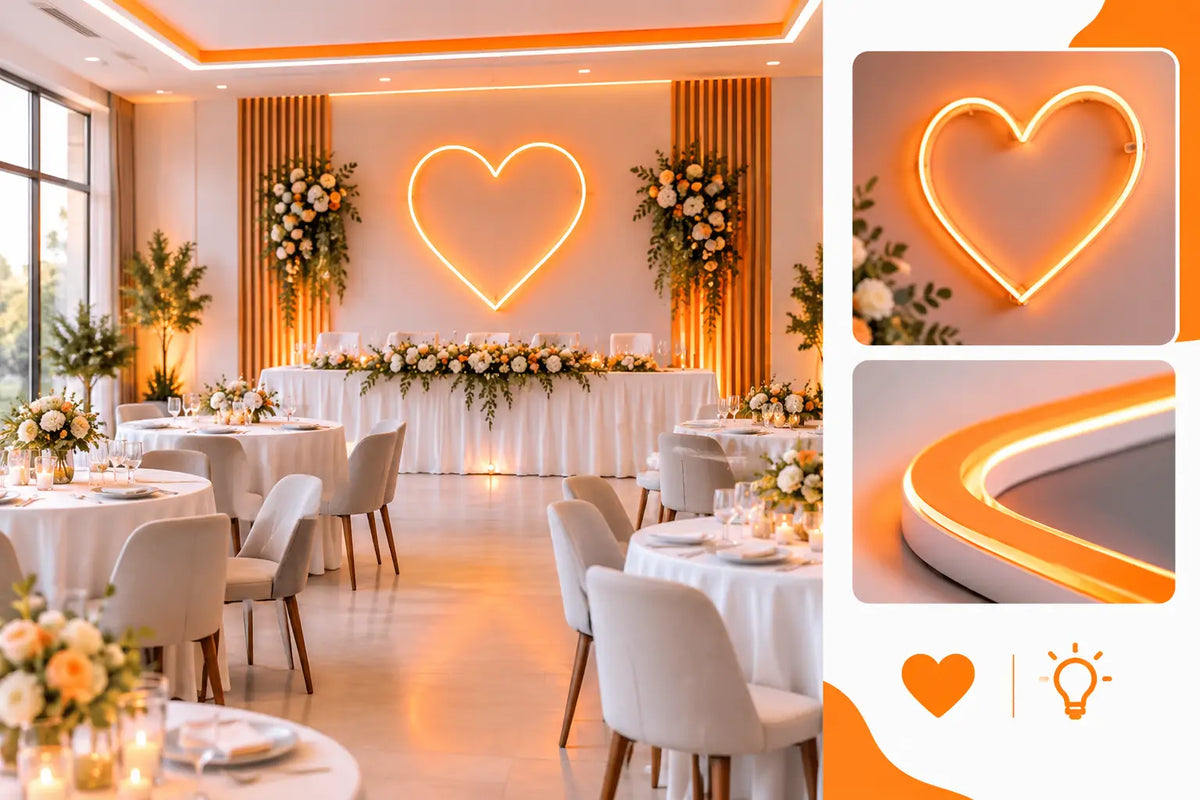
A wedding venue might have beautiful flowers, festively set tables, and a well-thought-out program. Yet, one striking focal point that guests naturally gravitate toward and that gives photographs an unmistakable atmosphere is often missing. An example of neon wedding venue decor shows that a lighted sign doesn't have to be just a decoration. It can become the newlyweds' personal signature, a backdrop for photos, and a detail that ensures the space doesn't remain anonymous.
LED neon works best where it has a clear purpose. Not as a randomly hung sign, but as an element that connects with the wedding colors, the ceremony site, the couple's names, or the energy of the evening celebration. Just choose the text, size, and placement well—and an ordinary hall gains its own character.
An example of neon wedding venue decor in practice
Imagine a wedding reception in a hall with high ceilings, light-colored walls, and long tables. Behind the head table stands a delicate flower wall in white, powder pink, and green. In the center glows a handmade LED neon sign with the names of the newlyweds and the wedding date, for example, "Klára & Matěj June 14, 2026."
The sign is in script font in warm white. In the evening, it doesn't overpower the floral decor or the faces at the table, but it softly highlights the place where the eyes of the guests and the photographer's lens are directed. During the day, it functions as an elegant detail; after dark, it creates a bright background for the first toast, cake cutting, and spontaneous family photos.
A second light motif can belong to the photo booth. On a more contrasting wall, perhaps with dark velvet, wooden slats, or a floral arch, a short message like "Better Together," "Today Forever," or a phrase the couple associates with their story can glow. This is where guests take the most pictures. Therefore, neon is not a secondary decoration—it is an active part of the experience.
The greatest advantage of such a solution is personality. Paper decorations or universal props are often lost among the rest after the evening. A neon sign with names can continue its life after the wedding in a home studio, cafe, showroom, or at another family celebration. A one-time moment becomes an item with a story.
Wedding style first, then light color
Neon decor doesn't look good just because it glows. It must match the overall visual language of the day. For a romantic wedding in a chateau or rustic space, warm white, champagne tones, or soft pink work well. They create a soft effect that combines well with flowers, fabrics, and wood.
A modern city wedding can handle a bolder contrast. Deep red, electric blue, or purple can support an industrial hall, black details, and an evening party atmosphere. Here, however, it is good to watch the intensity. If there are too many colors, the illuminated sign will begin to compete with the decor instead of giving it direction.
It also depends on the photographer and the style of the resulting images. Warm shades look more natural in portraits, while colored neon creates bolder night shots. Neither option is better for everyone. It depends on whether the photographs should appear timeless or capture the energy of a specific evening.
Short text has more power
Neon is not a billboard. The most readable are short texts, names, initials, a date, or a sentence of two to five words. A long quote might look nice in a design, but on a wall, it is often too small, less prominent, and disappears from a distance.
For the main wall, names and a date are suitable because they clearly belong to the couple. For a photo booth, a more playful text can work. Consider what you want guests to remember and what will look good in a shot cropped for social media. The sign "Forever together" can be more powerful than ten words that no one reads.
Where to place neon so it works for the space
Behind the newlyweds' table is the most common and very functional solution. The light here creates a natural center for the hall and complements the moments that are photographed most during the evening. It is important to leave enough free space around the sign. When it is surrounded by too many dense flowers, garlands, and other signs, its design and readability are lost.
A photo wall is the second ideal choice. Position it so guests can stop by comfortably without blocking service, the dance floor, or the path to the bar. It's not just about aesthetics. A photo booth must have space for groups, the photographer, and a few steps of distance from the background.
A welcome zone at the entrance to the hall also works interestingly. Here, neon can feature the couple's names, a simple "Welcome," or a motif that sets the mood for guests before their first drink. If the entrance area is smaller, choose a smaller sign and a calmer color. In a narrow hallway, you don't need grandeur, but a clear first impression.
Conversely, the dance floor is more suitable for short, energetic texts. A striking sign behind a DJ or band can lift the evening atmosphere, but it should not dazzle guests or disrupt the view. For this variant, it makes sense to discuss the installation with the venue coordinator in advance.
Size, material, and assembly are not details
With a neon sign, proportion is decisive. A small sign on a wide, bare wall will look lost. Too much text, on the other hand, will overwhelm a flower wall and the people in front of it. The design should therefore be based on a specific photograph of the place or at least on the dimensions of the wall, the height of the main table, and the planned background.
LED neon is usually produced on a clear, white, or color-treated acrylic base. A clear base lets the font itself stand out and is suitable for clean, elegant executions. A colored base can be part of a more striking composition, for example, when it follows wedding graphics or the corporate identity of the wedding venue.
Also think about the method of attachment. In some halls, you cannot drill into the walls; in others, you must adhere to the rules of a protected heritage space. The sign can be prepared for hanging on a structure, a flower wall, or a separate stand. The best idea can fail if it is addressed only on the day of the wedding, so it is practical to verify installation options in advance.
At AtmoSvetla, every LED neon is made by hand to order. A design and price quote can be obtained for free within 24 hours, and the design can be adjusted without limitations, so it makes sense to send a photo of the hall, the wedding palette, and an idea of the text. The LED neon is produced in 2 to 4 business days and undergoes 3 to 4 days of testing before shipping. If you want installation in the Czech Republic, it is advisable to confirm its terms before payment.
What often doesn't work and why
The most common mistake is choosing a sign that has no relationship to the location. A trendy English slogan might look good in an inspiration photo, but it might mean nothing in a historic hall with a family atmosphere. A personal phrase, initials, or date will carry more weight even years later.
The second mistake is trying to replace all decor with neon. An illuminated sign should be a magnet for the eyes, not a parade of all motifs at once. One main neon and perhaps one smaller secondary motif usually create a stronger result than three glowing texts in every corner.
Also, watch out for the light tone of surrounding decorations. If the hall has very cold lighting and you choose a soft, warm neon, the result in photos may appear unbalanced. This does not mean that shades cannot be mixed. It just requires working with them consciously and coordinating them with the photographer, florist, or wedding coordinator.
Let the light tell your story
The best neon wedding venue decor does not start with the question of which sign is currently popular. It starts with the question of what should remain in the guests' memory when the lights go out and the last song finishes playing. Send your idea, a photo of the space, and a few words about your wedding—a properly designed neon will give them a glow that will work in the hall and in every photograph.