

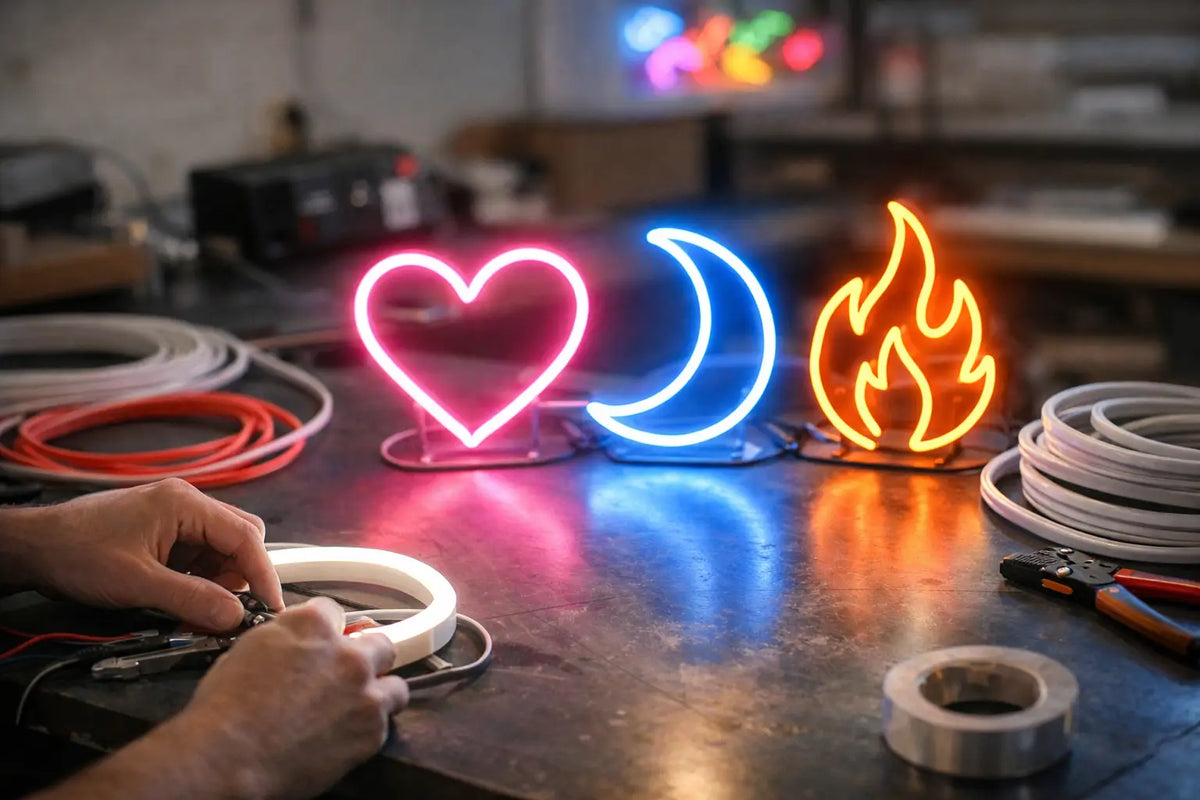
Some ideas simply beg to be illuminated. The name of a bistro behind the bar, a slogan at the reception, a wedding date above a photo booth, or a short word that gives a living room its own character. This is exactly where a guide to custom LED neons begins – not with technical parameters, but with the question of what the resulting sign should actually do in the space.
After all, a custom LED neon is more than just a decoration. When designed correctly, it acts as a landmark, a visual signature for a brand, and an element that changes the atmosphere of a room in seconds. And since every space and every intent is different, it pays to choose wisely. Not based on a single photo for inspiration, but based on what you want the light to bring to the room.
A guide to custom LED neons begins with the goal
The most common mistake is surprisingly simple – people focus on text, color, and font before clarifying the purpose. Yet, it is the purpose that determines almost everything. A neon for a café should grab attention, look great in photos, and make the business memorable. A neon for a bedroom or living room should be more atmospheric, pleasant, and in harmony with the interior. A gift neon, on the other hand, is built on personal significance and the element of surprise.
If you want a neon for business, think in terms of business context. Should it be visible from the street, or should it enhance the atmosphere inside? Should it display a logo, a claim, or just a simple symbol? For home use, ask yourself a different question – should it be the centerpiece of the room, or an accessory that just gently brightens the mood?
This distinction is crucial because a pretty design does not automatically mean a functional result. A flashy neon in a small space can feel overwhelming. Conversely, a subtle sign in a large establishment can easily get lost.
Text, logo, or symbol? Every choice has different rules
With custom LED neons, text is the most common choice, but it is not always the best one. A short word or a concise phrase usually works better than a long sentence. They are more readable, visually stronger, and easier to place. One striking word above a bar or in a conference room often does more than a long slogan stretched across an entire wall.
A logo is ideal where the light is meant to support brand identity. It fits well in receptions, showrooms, salons, offices, and gastro establishments. However, it is good to keep in mind that not every logo can be converted into an LED neon without adjustments. Very fine details, thin lines, or complex gradients sometimes need simplification so that the final result remains clean and legible.
Symbols and graphic motifs have one great advantage – they work even without text. A heart, a lightning bolt, a silhouette, a glass, an outline of a logo, or a custom illustration can liven up a space quickly and without unnecessary literalism. They are often a great solution for apartments, events, or visually strong establishments where there is no need to explain everything in words.
How long a text is still a good idea
In general, the shorter the text, the greater the visual power. But that does not mean that longer signs don't work. They just require more space, more careful typesetting, and a reasonably chosen font. If the text is hard to read at first glance, the neon loses part of its effect.
For commercial projects, it is better to think about readability from various angles and distances. For home and gift pieces, you can afford more playfulness or a more personal message. But even then, less is often more striking.
Color is not a detail. It is mood and strategy
The color of an LED neon determines how the space will feel. Warm white creates a softer and cozier atmosphere, while cooler shades feel more modern and technical. Pink, blue, or red attract attention immediately and are suitable where you want to create a visual moment.
In business, the color is often dictated by branding, but it does not always pay to stick blindly to the corporate palette. Sometimes it is better to choose a shade that will work better in the space while maintaining the brand's character. For example, dark interiors can handle a bolder neon, while in a delicately tuned space, a loud color might be distracting.
Home interiors tend to be more sensitive to coordination. A neon should capture interest, but it shouldn't visually overpower the room. If you want a long-term satisfying result, choose the color not just based on the current trend, but also based on the materials, walls, and the type of light you already have at home.
Size and placement determine whether a neon shines
This is where the difference lies between a successful piece and a light that only looks good on a screen. A custom LED neon must fit proportionally. A small sign on a large empty wall can look lost. A neon that is too large in a compact interior can easily overwhelm it.
When choosing the size, it is good to take into account the distance from which the neon will be viewed most often. A different dimension makes sense behind a reception desk, another above a bed, and another for a shop window. The installation height and surrounding elements are also important. Next to shelves, paintings, or decorations, a neon needs enough space so that it doesn't get lost.
Which background works best for neon
It stands out best on a clean wall or a background that leaves it room to breathe. A darker background emphasizes the glow, while a light one feels softer and airier. A transparent backing is often popular where you want the cleanest impression, while a solid board can be more practical for bolder shapes or mounting in commercial spaces.
It also depends on whether the cable should be visible or hidden. In some interiors, a visible technical line is part of the style. In others, a cleaner installation makes more sense. It is often the details of the installation that decide whether the result will look truly professional.
A guide to custom LED neons without unnecessary technical jargon
The good news is that with LED neons, you don't have to deal with the complex maintenance or fragility of classic glass neons. That is precisely why it is so popular today in homes and businesses. It is lighter, more practical, and suitable for a wide spectrum of uses.
But that doesn't mean the technical side doesn't play a role. It is important to know whether the neon will be indoors or outdoors, how it will be powered, and if you need dimming or remote control. For some, clean design is key, for others, it's the ability to change light intensity according to the time of day or type of event.
It is worth keeping in mind that a neon for a café, showroom, or salon often runs longer than a decoration at home. Therefore, it is good to address not just the look, but also the practical side of operation and long-term reliability.
From idea to finished piece: what to prepare before ordering
The clearer the brief, the better the result. You don't need a finished professional design. It is enough to know what you want to write or display, where the neon will go, and what mood it should create. A photo of the space, approximate dimensions, and a few visual references will also help.
If it concerns a logo, it is ideal to provide a high-quality source file. For text, it is good to specify whether you prefer an elegant script, a clean modern font, or something more playful. It is also important to define your expectations for the result. Do you want a dominant statement piece, or a subtle light detail?
This is exactly where working with a manufacturer who can provide advice not just technically, but also visually, makes sense. At AtmoSvetla, an order is not treated as a mere production of a sign, but as the design of light for a specific atmosphere and a specific goal. And that is a difference that shows in the result.
When it pays to go custom and when it's better to choose a ready-made design
Custom LED neon is the best choice when you want originality, specific dimensions, or a stronger connection to a brand or a personal story. For companies, a custom order is often the clear choice because the space and brand identity require a tailored solution. For households, it depends on whether you are looking for a unique element or rather a quick and more budget-friendly way to liven up the interior.
A ready-made design makes sense if you like a specific motif and don't need to change anything. A custom order, conversely, is better where the light needs to fit exactly in terms of size, visuals, and meaning. It is not always a question of a better or worse option. It is more a choice between a quick effect and a solution that will feel truly personal.
What makes a good neon truly good
Not just the color. Not just the text. And certainly not just the fact that it glows. A well-designed custom LED neon works as part of the space. It attracts attention but doesn't seem random. It supports the atmosphere, style, and purpose of the room. And when it is designed correctly, you won't get tired of it, neither after a week nor after a year.
The best executions are usually those that have a clear intent while respecting the space they are going into. They don't need to be cluttered to be seen. A good idea, the right size, a suitable color, and a clean finish are all that’s needed.
When you are not sure, don't start with the question of what neon is currently popular. Start with what you want people to feel or see the moment it lights up. This is where lights that are not just pretty, but truly functional, are born.
💡 Do you want to design your own LED neon?
Try our online LED neon configurator — select your text, color, and size and see the price immediately.