

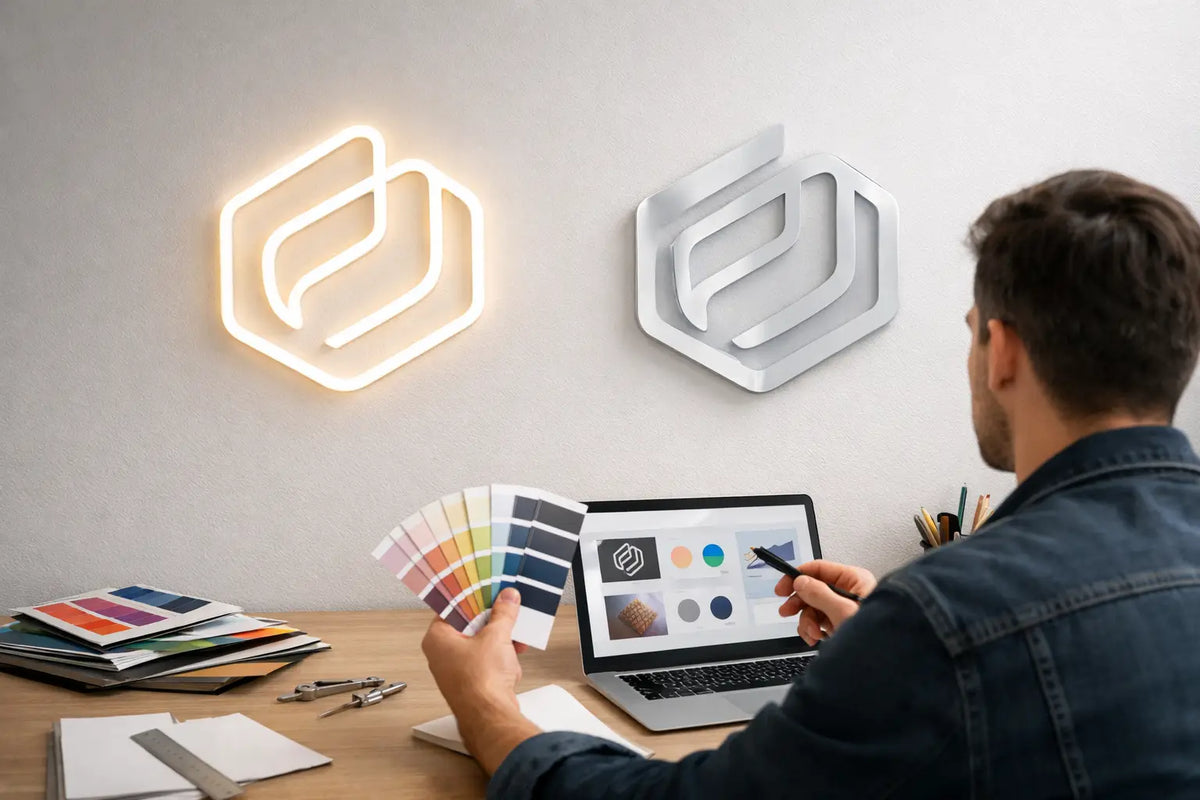
A shop window without a distinctive logo can easily blend in with dozens of others. That's why the question of LED neon versus plexi logo is not just a decision about material. You're deciding how your brand will appear from the street, in photos, after dark, and at the customer's first step into your space. One option works with glow and emotion, the other with clean form, color, and professional presentation.
For a café, salon, showroom, or modern office, a well-chosen logo can transform an ordinary wall into a memorable spot. However, there's no single right answer for every brand. It depends on the style of the establishment, the distance from which the brand needs to be legible, the lighting conditions, and what the logo should communicate to the customer.
LED neon versus plexi logo: the main difference
LED neon is a luminous sign made from modern LED strips hidden in a flexible silicone profile. The glowing line traces text, a symbol, or a simple motif, creating an effect reminiscent of classic neon, but without its fragility, high energy consumption, and complex maintenance. It works best where a brand needs to catch the eye, set a mood, or add energy to a space.
A plexi logo is usually made from acrylic. It can take the form of a flat panel with UV print, colored cutouts, multiple layers, or raised 3D letters. It might not be illuminated at all, or it could be backlit or supplemented with separate lighting. Its strength lies in the precise representation of corporate identity: logotype, fine details, color fields, and more complex graphics.
Simply put: LED neon draws with light. A plexi logo builds the brand in substance. If you want passersby to stop and look, LED neon naturally has a stronger effect. If you need a representative sign for a reception, office, or premium store, plexi often appears calmer and more formal.
When LED neon wins
LED neon has a big advantage in evening visibility. While a regular printed or colored logo needs external light after dark, neon glows on its own and becomes an active part of the space. In a bistro, it can create a photo booth; in a barber shop, it can add character to the interior; and in a fitness studio, it can foster a dynamic atmosphere.
It looks best with short slogans, names, icons, and distinct outlines. Handwritten fonts, simple symbols, product outlines, or clear slogans that are easy to read in a few seconds are particularly effective. Neon isn't ideal for long paragraphs, very thin fonts, or logos with dozens of tiny elements. A luminous line needs space to truly shine.
The term LED doesn't automatically mean a garish result. Warm white, amber, soft pink, or subtle blue can look elegant. Proportion is key. A small sign on a large blank wall can work as a detail, while an overly large and aggressively colored motif can easily overpower the entire interior.
LED neon is also a practical choice for businesses that primarily operate in the afternoon and evening hours. A bar, restaurant, music club, or beauty studio gets a luminous element that works even when it's dark outside and competitors lose visibility.
What to consider before designing a neon logo
First, determine where the sign will be seen from. A neon sign above a bar can be more subtle and detailed because guests view it up close. A window logo needs bolder strokes, higher contrast, and sufficient size for legibility from the sidewalk or road.
The background is also important. Transparent plexi lets the light itself stand out and appears airy. A black, white, or colored background can, on the other hand, strengthen the composition and increase contrast. Sometimes it's best if the background is almost invisible. Other times, it becomes part of the design, for example, in the shape of a circle, arc, or your symbol's outline.
When a plexi logo makes more sense
A plexi logo is a more precise medium for graphic identity. It can faithfully display more colors, gradients, fine lines, illustrations, and more complex corporate emblems. If your brand is built on specific typography, a particular shade, or a detailed icon, acrylic will give you more freedom than a glowing neon tube.
It works very well in receptions, offices, salons, shops, and entrance halls. 3D layering creates shadows and depth, making the logo appear high-quality even without illumination. During the day, it's generally more legible than neon, especially where there's a lot of natural light. UV printing then allows for clean colors and precise graphics on plexi without compromise.
Plexi is also a good choice when you want to expand the brand across a larger area. It can include the logo, a slogan, opening hours, navigation elements, or even a product illustration. Such an element doesn't have to dominate with light, but it can still unify the space and give it a professional order.
This doesn't mean that a plexi logo has to appear cold. Smoked plexi, mirrored acrylic, a matte surface, or a combination of multiple layers can create a luxurious, playful, or very contemporary impression. The result is less about glow and more about material, relief, and detail.
Cost, maintenance, and lifespan in real operation
When comparing LED neon versus plexi logo, the price cannot be judged solely by size. For neon, it's influenced by the length of the light line, the complexity of the shape, the number of colors, the type of backing, and the power supply. For plexi, the material thickness, number of layers, printing method, cutouts, and potential backlighting play a role.
A flat plexi sign with UV print is often a more affordable way to achieve a larger area with detailed graphics. A simple LED neon, on the other hand, can be a very effective investment if you need one strong visual moment. However, a complex neon sign with many tiny curves can cost more than an elegant 3D logo made from two layers of acrylic.
In terms of operation, both solutions are low-maintenance. Plexi only needs to be cleaned with a soft cloth and no aggressive agents that could scratch or dull the surface. LED neon requires properly placed power supply and gentle wiping. For both options, long lifespan depends on quality manufacturing, well-prepared mounting, and use in the environment for which the implementation is designed.
For outdoor use, always consider specific conditions. Rain, dust, direct sunlight, frost, and placement near a busy road all affect the choice of materials, enclosure, and installation. What works excellently as decoration inside a café may not automatically be ready for a facade.
The strongest solution often combines both options
You don't have to choose only one direction. Many brands achieve the best results by combining plexi and LED neon. Plexi can carry the main logo in precise corporate colors, and neon can highlight a slogan, icon, or part of the name. This gives you legibility during the day and emotion after dark.
Imagine a reception with a dimensional logo on a matte wall and a softly glowing motto next to it. Or a shop window where the business name is rendered in clean plexi, while a neon illustration of a cup, flower, or scissors attracts attention from the street. Light then is not a replacement for identity, but its clever accent.
Such a combination has another advantage: you can decide based on the function of individual elements. Important information will remain sharp, true, and easy to read on plexi. The element meant to evoke emotion and invite people in will receive luminous energy.
How to decide based on brand character
If you're selling an experience, mood, creativity, or evening atmosphere, start with LED neon. It's suitable for hospitality businesses, the beauty segment, studios, events, gaming zones, and brands that also want to be seen on social media. It's an element that naturally invites a photo.
If you're building on trust, precision, premium service, or a consistently presented long-term image, look at the plexi logo first. It often fits better for law firms, clinics, real estate companies, showrooms, and companies with a detailed visual identity guide.
And if you don't want to compromise on either character or legibility, combine both approaches into one design. At AtmoSvetla, just send your idea, logo, or a photo of the space. A free design will show whether a luminous line, dimensional acrylic, or a combination that transforms an ordinary wall into a place with its own atmosphere, suits your brand best.