

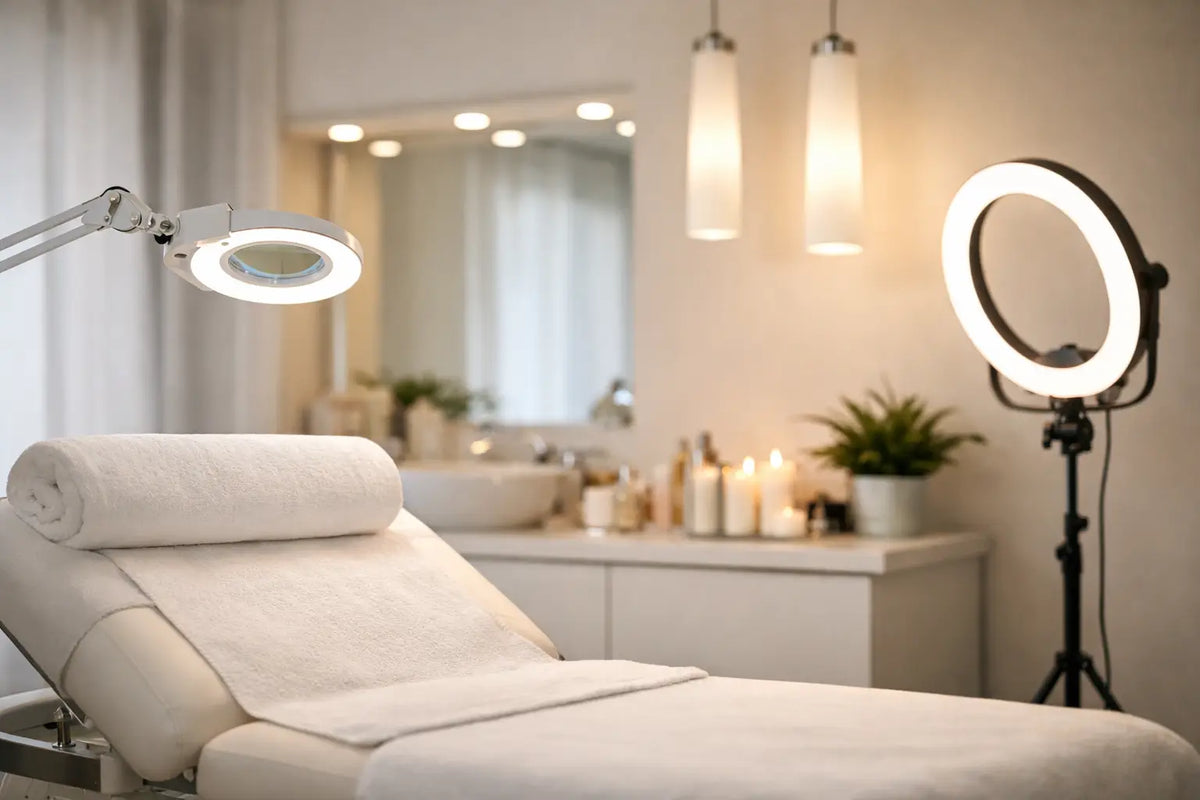
When a client sits down on the treatment bed, she notices more than just the service. She perceives her skin tone in the mirror, the cleanliness of the space, the sense of calm, and whether the salon feels professional. That is precisely why lighting for a beauty salon is much more than a technical detail. It is part of the first emotion, the quality of work, and whether the customer will book again.
In a beauty salon, light does not play a supporting role. It is what the beautician uses to assess the condition of the skin, details during cleansing, skin tone after treatment, and the precision of the final result. The customer uses it to judge whether she feels safe, well-groomed, and in good hands. Well-designed light must therefore do two things at once—be functional for work while creating an atmosphere that sells.
Why lighting is so crucial for a beauty salon
A beauty salon is neither a living room nor an office. It needs layers of light that work in different situations throughout the day. A single ceiling light is not enough, as it creates shadows under the eyes, nose, and chin. This complicates skin diagnosis and delicate work.
At the same time, it is not true that the stronger the light, the better the result. Overly harsh or cold lighting can make a space uncomfortable, highlight imperfections more than the client would like, and create a sterile impression. In a salon that sells care, relaxation, and trust, this is a problem.
Good light must be precise where work is being done and softer where the mood is being set. This is often the biggest difference between a space that is simply lit and a salon that feels well-conceived.
What kind of light a beauty salon really needs
The best result is usually not achieved with one type of fixture, but by a combination of multiple sources. Each zone in the salon has a different task, and the light should respect that.
Central light for an overall view
The foundation is even ceiling lighting. This should open up the space, visually clean it, and eliminate dark corners. It is ideal to have lighting that does not flicker, does not distort colors, and spreads light evenly throughout the room. In smaller salons, a wider beam is often more practical than showy spotlights, which create harsh cones and unnecessary contrast.
If the salon has high ceilings or a complex floor plan, it is worth supplementing the central light with additional points—not for effect, but to ensure that the workspace is never in partial shadow.
Task lighting by the treatment bed
This is where the quality of service is decided. Lighting by the bed must be intense, precise, and adjustable. The beautician needs to see skin texture, tiny impurities, and skin reactions during treatment. A directional lamp or a professional task light that can be moved as needed is usually practical.
Light temperature is also important. Light that is too warm distorts skin tone and obscures detail. Light that is too cold feels harsh and tires not only the client but also the staff's eyes. Neutral white works well in most salons, maintaining true colors while still feeling pleasant.
Mirror lighting without unflattering shadows
If a client is to check her skin or makeup after a procedure, the light at the mirror must be flattering but honest. This means lighting from the front or sides, not just from above. Overhead light by itself creates sharp shadows and visually adds fatigue to the face.
Evenly illuminating the face works best, showing the result as it will look outside. This gives the salon a more professional image and gives the client greater confidence in what she sees.
Atmospheric light in the waiting area
The reception and waiting area have a different task than the workspace. Here, the light does not need to be so technical. It should slow down the pace, soften the space, and put the client at ease before the actual treatment. This is exactly where designer lighting can make a big difference.
Table lamps, wall lights, or subtle decorative accents will help distinguish the salon from sterile facilities. And if you want customers to remember you visually, subtle light branding or a neon sign in the background or near a photo corner can work wonders. When a space looks good in person and in photos, it works for you even outside of the actual visit.
How to choose the right light color
One of the most common mistakes is underestimating color temperature. Yet, it is precisely this that determines whether a salon feels cozy, clinical, or unnatural.
Warm light is pleasant for relaxation, but it can be distorting in a purely work-focused zone. Cold light supports concentration and detail, but in excess, it feels harsh. For a beauty salon, it is therefore most sensible to work with a combination. Keep to a more neutral light in the treatment area, and add softer tones in the waiting room and at the reception.
The color rendering index is similarly important. If the light does not render shades well, the skin looks different than it actually is. This is a disadvantage during both diagnosis and the presentation of results. In a salon where you work with faces, color fidelity is a basic requirement, not a bonus.
What is often forgotten
Salon owners focus on the appearance of the fixtures, but less so on their placement. Yet it is the position of the light that determines whether the space will work. A beautiful fixture will not help if it illuminates from the wrong angle or blinds the client while lying down.
The second common mistake is lighting the entire salon too uniformly. The space then feels flat and characterless. A salon needs rhythm—the client should feel something different upon arrival, something different during the consultation, and something else during the treatment itself.
Evening operation is also often forgotten. During the day, natural light may help, but after dark, it becomes clear whether the design is truly functional. If the salon only looks good in the sunshine, something is missing in the design.
Design and business effect go hand in hand
A beauty salon sells a service, but also an image of the brand. When a space is thoughtfully lit, it appears cleaner, more expensive, and more confident. This does not mean it has to be flashy. On the contrary. Often, a restrained foundation complemented by one striking element that clients will associate specifically with your business works best.
It could be a backlit logo at the reception, a subtle light inscription on the wall, or a designer lamp that creates the signature of the space. This is precisely where light turns from a necessity into an identity. And in the beauty industry, identity is a strong currency.
If a salon shares results on social media, organizes transformations, or relies on visual presentation, quality light also helps with marketing. Photos look cleaner, the skin more natural, and the interior more professional. That is an effect that is hard to replace with a filter.
When a custom solution pays off
Ready-made fixtures make sense where the space is simple and needs are clear. However, as soon as a salon combines several functions, works with a distinct aesthetic, or needs to support branding, it is often better to think of the solution as a whole.
Going custom is worth it especially when you don't just want to light a room, but to create an environment that has a clear handwriting. For brands that want to appear modern, clean, and memorable, a lighting concept makes great sense. It's not just about what the client sees when she enters; it's about what she takes with her in her mind after the visit.
That is why it makes sense to choose a partner who understands not only the parameters of light but also how the space affects people and the business. AtmoSvetla builds light as a tool for atmosphere and identity, which is exactly the type of approach for salons that can connect functionality with an impression.
Lighting for a beauty salon as an investment, not a decoration
When light is chosen well, work is more precise, the space feels calmer, and clients feel better in it. When it is chosen poorly, a salon can have beautiful furniture and great services, but the whole will not work. Light reveals everything—the quality of the space, the details of the treatment, and the level of the brand.
It is therefore worth asking yourself not just what will provide light in the salon. The better question is what feeling the space should evoke and what it should support. Once you clarify this, light will cease to be a mere line item in the budget and will begin working in your favor every single day.