

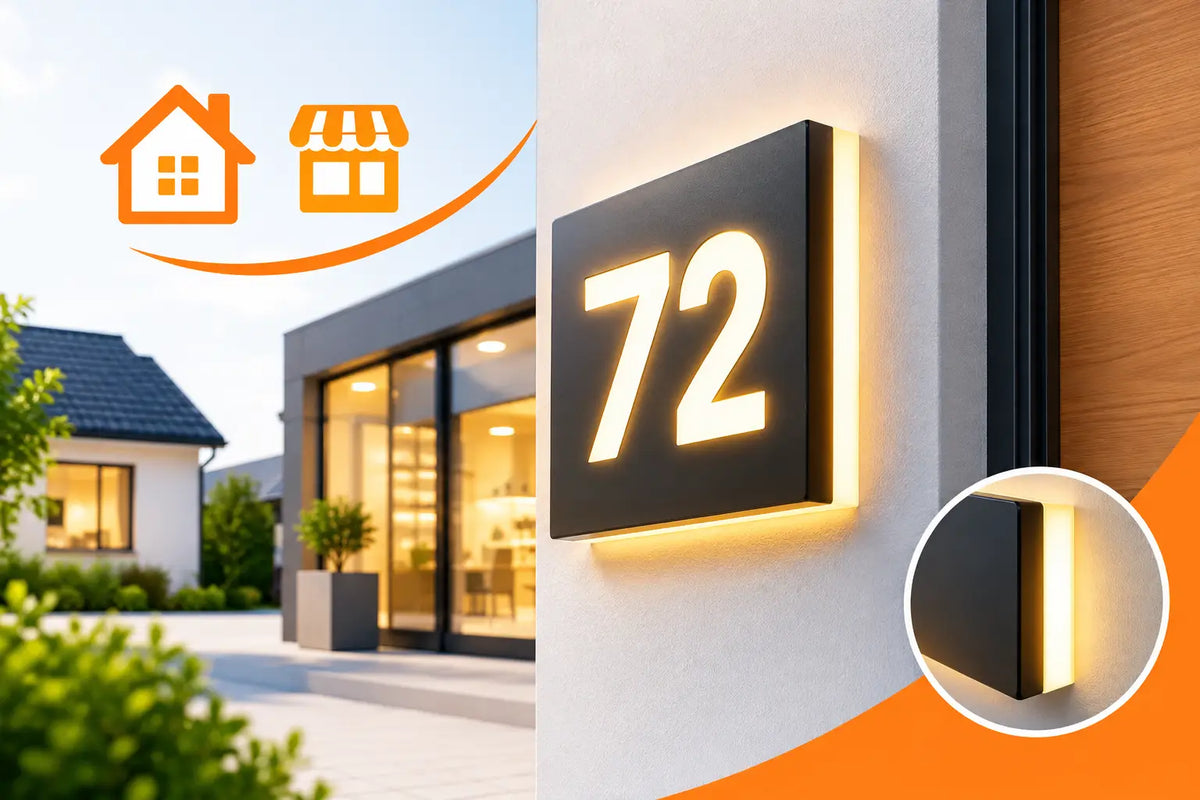
A guest is looking for the address, a courier slows down along a row of dark facades, and your entrance stays unnoticed. This is exactly when an illuminated house number makes sense. It is not just a practical detail for coming home in the evening. It is the first clear point that says: you're in the right place. On a family house, it supports a clean-looking entrance; for a salon, bistro or studio, it helps customers find the door without unnecessary searching.
A well-designed number doesn't look like a technical add-on attached at the last minute. It can tie in with the architecture of the facade, your brand colours and the character of the place. Here, light doesn't serve as ordinary lighting. It creates orientation, atmosphere and a memorable first impression.
Why an illuminated house number works better than a regular plate
A classic plate does its basic job during the day. In the evening, though, it often blends into the render, dark cladding or the surroundings of the entrance. An illuminated version stays legible at dusk, in the rain and in the winter months, when people come home or to a business after dark.
The difference is most visible where the house is set back from the street, the entrance is behind a gate, or the facade uses darker materials. For businesses, the benefit is even more direct: a customer who finds the address easily doesn't start the visit frustrated. For a beauty salon, surgery, apartment, showroom or pick-up point, a clearly marked entrance can be the small detail that shapes the overall impression.
The light effect should be used with restraint, though. The goal is not for the number to compete with the main logo or shop window. It should be striking, legible and in harmony with the space. Subtle backlighting works differently on a historic facade than bold 3D numbers on a modern commercial building.
First, tell the descriptive and the orientation number apart
In everyday Czech, everything is often called a “číslo popisné” (descriptive number), but address marking can also include a “číslo orientační” (orientation number). The descriptive number identifies a specific building, while the orientation number helps with the address within the street. Some buildings therefore need both, others only one.
Before production, it's a good idea to check what marking the building should carry and what rules apply in your municipality or city district. Local requirements may differ, for example in colour, size, placement or the form of the plate. An illuminated solution can elegantly complement this information, but it should not replace the prescribed marking without checking first.
A practical option is a separate illuminated number next to the standard municipal plate. Another is a custom sign that combines both numbers while respecting the required legibility. The right solution always depends on the facade, local rules and whether you are marking a private house, a multi-generational building or a business.
Material shapes both look and impression
An illuminated number doesn't always have to look the same. The material determines its character, contrast and how naturally it fits in with the door, cladding, render and other signage.
Acrylic suits a clean, modern and colour-accurate finish. It allows you to work with UV printing, layers and bolder graphics. It is a good choice for owners who want the number to match the visual style of their company, the name of their accommodation or the colour of the entrance elements.
Metal brings a firmer, architectural expression. It looks great on brick facades, concrete, stone and minimalist new builds. It can come across as discreet and premium, especially when the light is designed as a soft glow around the edges or behind the digits.
An interesting result often comes from combining materials. A metal front element with backlighting, or an acrylic panel with a contrasting number, can combine practicality with a distinctive look. Don't choose based on a photo alone. What matters is what will work on your facade, both by day and after dark.
Flat plate or 3D digits?
A flat plate is compact and clear. It works well if, besides the number, you need to show the name of the business, the street, a pictogram or a short wayfinding message. It also has the advantage of creating a clearly defined design unit.
Separate 3D digits, on the other hand, give the facade more room. They suit modern houses, hotel entrances and businesses that want to work with a more pronounced three-dimensional look. Backlighting behind the letters or digits creates a light outline on the wall and looks very clean. However, it needs a suitable background and enough space for the effect not to get lost.
Light colour: atmosphere yes, legibility always first
Warm white light feels welcoming and goes well with wood, sandy tones, brick and more traditional architecture. Cooler white suits modern facades, glass, black metal and distinctly contemporary design. Both can look great – it depends on the context.
Coloured light makes sense mainly where it ties in with the brand identity. Blue can support a tech studio, pink a beauty business, and a bold colour a business that wants to be seen from the street. For address marking, though, one simple rule applies: design must not beat legibility. If a visitor can't make out the digits within a few seconds, the effect is too complex or lacks contrast.
Also watch out for the surrounding street lighting. On a busy avenue with many illuminated surfaces, the number needs more contrast than in a quiet residential area. Conversely, in a dark setting, brightness that is too strong can be unpleasant. That's why it's always better to judge the design against the real location, not just internet inspiration.
The outdoor version is not an optional extra
A facade faces rain, dust, frost, summer sun and temperature changes. That's why, for address marking, it's important to choose an outdoor version from the start and to think through the mounting and power routing. The result must not only look good in a photo but also be ready for everyday use.
The cleanest result comes when the electrical preparation is sorted before installation. The cable then doesn't have to disrupt the finished facade, and the element itself gets room to stand out. With renovations, a compromise is often needed. Even that can look good if the power route and the placement of the number are planned around the specific entrance.
For businesses, it's a good idea to coordinate address marking with other wayfinding: the logo, opening hours, doorbell label or a sign pointing to the entrance. They don't need to be the same size or shine with the same intensity. But they should speak one visual language.
How a number that isn't just “any number” is made
Custom production starts with questions that may seem minor: From what distance should the number be legible? What colour is the facade? Is there a logo, doorbell or door camera at the entrance? Should the marking be mainly elegant, or impossible to miss? It's exactly these answers that decide whether the result will look natural.
At AtmoSvetla, illuminated signs and plates are made by hand to suit the specific space and brief. You can get a design and quote free of charge within 24 hours, or within 2 working days for more complex orders, with unlimited design revisions. Illuminated house numbers start from CZK 2,500, but the final price depends on size, material, graphics and the chosen lighting solution.
Before ordering, prepare a photo of the location, the approximate dimensions of the available area and an idea of whether the marking should glow softly or be visible from further away. If you need installation, it's best to confirm the details before payment. Installation within the Czech Republic is provided by partner teams from CZK 1,000.
Illuminated address marking is a small element with a surprisingly big effect. When it is designed for a specific facade and for the specific people heading towards it, it won't remain just a number on the wall. It becomes a clear invitation: this is where your space begins.