

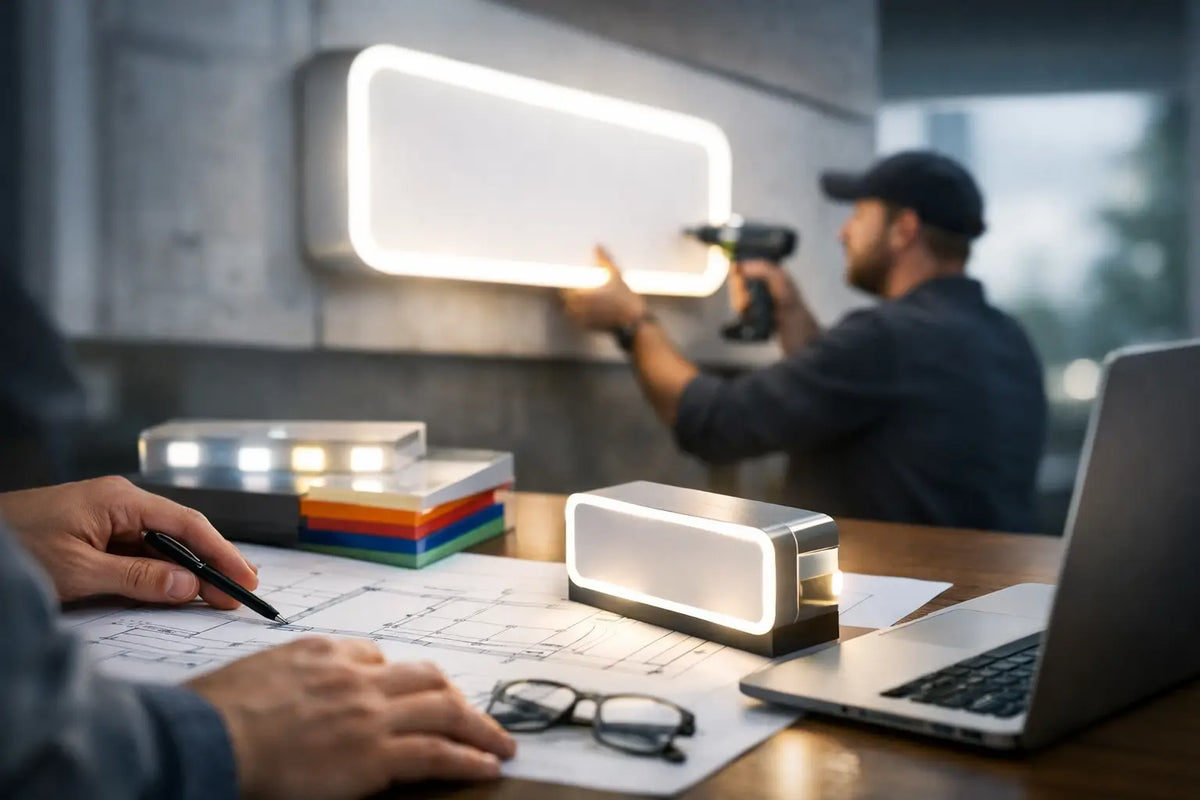
The shop window is empty, the wall above the bar is bare, the logo at reception is fading into the background, and passersby just walk on. That is precisely the moment when the question of how to order illuminated signage makes real sense. It’s not just about lighting something up. It’s about creating an element that catches the eye, fits the space, and helps your brand be seen and remembered.
Illuminated signage is no longer the exclusive privilege of large corporations. A well-designed LED neon, 3D logo, or light-up sign works just as well in a café, showroom, hair salon, or even a home interior where it adds character. The difference between a successful order and an unnecessarily expensive mistake lies mostly in how clearly you define your goal at the start.
How to order illuminated signage step-by-step
The first step is not choosing a color or a font. It is deciding what the signage should actually do. Should it be visible from the street, highlight a logo in the interior, create an Instagram-worthy feature, or set the mood in a space? Each of these goals leads to a slightly different solution.
If you want to attract attention from the outside, readability, contrast, and durability will play a bigger role. If you are dealing with illuminated branding inside a business, you can afford more subtle work with details, colors, and effects. And if you are ordering a light-up sign for your home or as a gift, personality often triumphs over purely promotional function.
Once you are clear on the purpose, it’s time for the materials. The best start is simple and practical – send the text, logo, size expectations, and a photo of the spot where the signage should go. You don’t need a finished technical drawing or a perfect visualization. On the contrary, a quality manufacturer should be able to take your idea and turn it into a design that works both aesthetically and structurally.
What to prepare before sending an inquiry
The more specific the brief you send, the faster you will arrive at a design. For a text sign, it helps to provide the exact wording and perhaps a font style you like. For a logo, it is ideal to provide vector files or at least a high-quality source file. Information about the location is also important – interior, exterior, wall, window, reception, photo booth, or shop window.
Many customers underestimate the scale. Everything looks bigger and more striking on a screen than it does in a real-life space. Therefore, it is smart to measure the width of the wall, the distance from the entrance, or the viewing angle. Illuminated signage must be readable in the space and proportionally correct. A sign that is too small will get lost, while one that is too large will begin to suffocate the room.
It is also good to think about power. For some installations, an outlet is right at hand, while for others, you will need to plan for cable routing or prepare the mounting surface. It isn’t complicated, but it is better to address it before production begins.
The design matters more than the production itself
When the manufacturer prepares a design, don't just start by asking if you like it. Ask yourself if it will be readable, if it fits the brand style, and if it suits the space. A beautiful design in isolation doesn't necessarily mean it will work on site.
This is where the difference between an ordinary order and a smart implementation shows. Sometimes it is better to choose a simpler sign with more impact than complicated details that get lost. Other times, it is worth adding a 3D element or UV printing if the result is intended to feel more premium and representative.
With illuminated signage, less is often more. Especially with logos and short slogans. When you try to cram too much information into one light element, the effect weakens. People remember a shape, a word, a color, and a mood. Not a paragraph of text.
LED neon, 3D logo, or a light box?
This is a common question, and the answer is not the same for everyone. LED neon is bold, modern, and works great with atmosphere. It fits into gastro businesses, salons, studios, shop windows, and home interiors. Depending on the execution, it can be playful, elegant, or bold.
3D logos feel more representative and often more professional. They are ideal where the brand needs to inspire trust and a strong visual identity – for example, at reception, in an office, or in a showroom. A light box makes the most sense when you need high visibility and clear readability from a greater distance.
It is not a competition where one solution beats the other. It depends on the space, budget, and goal. Sometimes a combination is best, such as a clean 3D logo complemented by a neon claim in the interior.
Price is not just about size
When people try to figure out how to order illuminated signage, they often want to know the price as soon as possible. That is understandable. However, the price is not derived just from the number of centimeters. It involves the complexity of the design, the type of material, the manufacturing method, the colors, the installation, and whether it is for an interior or exterior.
A cheaper solution doesn't have to be bad, but it should make sense. If the sign is hanging inside and is mainly there to create atmosphere, the design can be simpler and more affordable. But if the element is meant to work outside, it must handle the weather, longer operating hours, and higher durability requirements. That is where it pays not to cut corners in the wrong places.
A good sign is transparent calculation and clearly explained options. A high-quality partner doesn't just sell you a light object, but a solution. This means they will tell you where it makes sense to invest and where, conversely, it does not.
Most common ordering mistakes
The most common mistake is a vague brief. When a customer sends only a sentence like "I want some neon for my business," it is difficult to suggest something precise. The second mistake is underestimating the scale. The third is usually an overly complicated design that looks good in your head but loses its power in light.
Another problem is not addressing the environment. Signage for a minimalist interior is designed differently than for a busy street, or for an evening bar where the light creates an atmosphere together with the music and surrounding materials. Good illuminated signage is not a solitaire. It must work with its surroundings.
And then there is time. If you need signage for a business opening, a trade fair, or a seasonal event, order well in advance. Design, approval, production, and potential installation all need their own time. When you push everything to the last minute, you unnecessarily narrow your options.
How to tell if a design is really good
You can recognize a good design simply. Even if you only look at it for a few seconds, you immediately know what it says and what the mood is. It is readable, has character, and doesn't look like a random accessory. It looks natural in the space, but at the same time, it knows how to demand attention.
It helps to imagine three situations: How the sign will look during the day, how it will look in the evening, and how it will look in photos or videos. This is crucial today, especially for businesses that want people to share their space. A light element should not only be seen but should also create an experience.
This is exactly where collaborating with someone who understands both design and production makes sense. AtmoSvetla builds its commissions on the fact that the customer brings an idea and it is transformed into a lighting solution that works both visually and practically – from free consultation and design to final production with a two-year warranty.
How to order illuminated signage when you only have an idea
Many great projects don't start with a finished brief, but with the sentence, "I have an idea, but I just don't know how to grasp it." And that is completely fine. If you know what feeling you want to evoke, where the sign will be placed, and who it is intended for, the rest can be fine-tuned.
Some want warm light and subtle elegance, others want sharp contrast and an effect that cannot be ignored. Someone needs a logo above reception, another a sign for a beauty studio or a neon gift for an apartment. Each of these intentions needs a slightly different approach, but the principle is the same – start with the space, the brand, and the purpose, not with a random picture from the internet.
When you approach your order this way, illuminated signage will be more than just decoration. It will become part of the place's identity. And that is exactly the moment when light doesn't just start to glow, but actually starts working for you.
💡 Do you want to design your own LED neon?
Try our online LED neon configurator — select text, color, and size, and see the price immediately.