

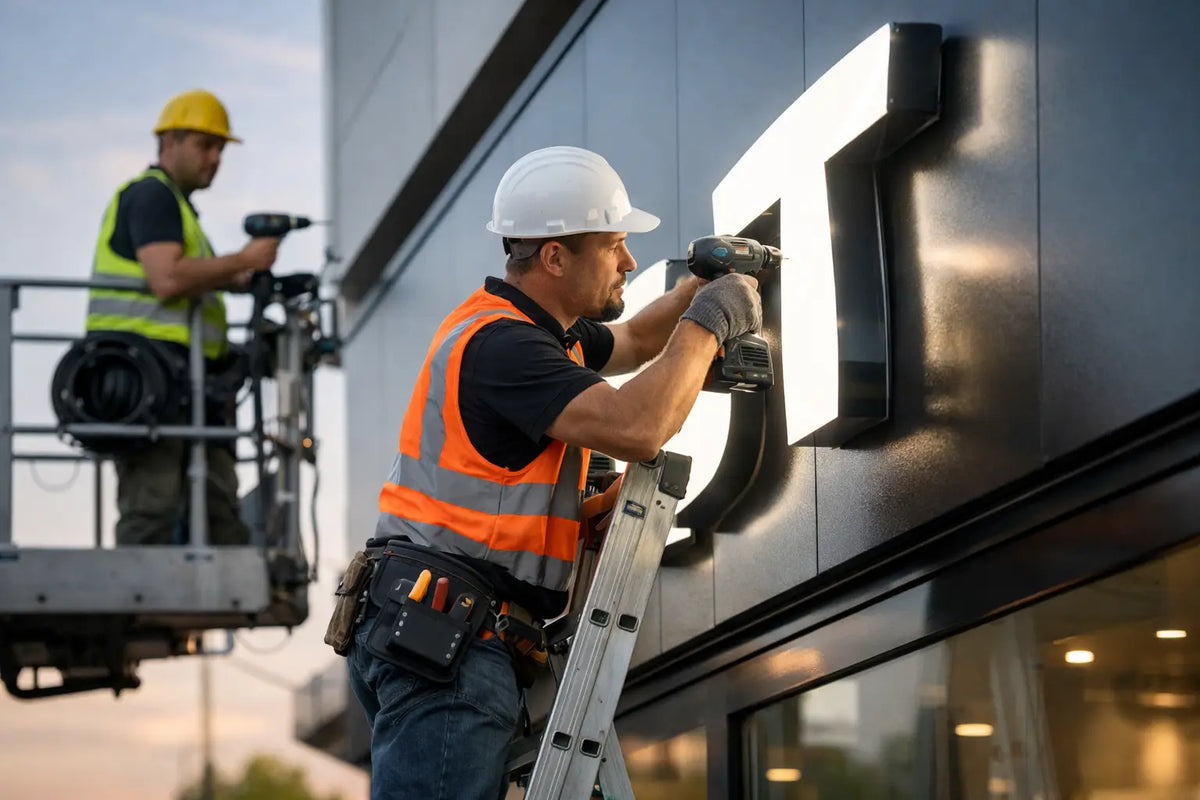
The storefront may be full of beautiful goods, the interior perfectly designed, and the logo precisely crafted. However, if the illuminated sign hangs crookedly, dazzles guests, or gets lost in the ambient light, the first impression will fall apart within seconds. Therefore, the installation of illuminated advertising is not a minor detail to be handled after production. It is the moment when the design turns into a visible part of your space and starts working for your brand.
LED neon signs, 3D logos, and backlit boards have a different character than an ordinary picture on the wall. They work with electricity, weight, surface, the gaze of passersby, and the atmosphere in the interior. A well-executed installation lets the shape, color, and light stand out. A poorly executed one, conversely, draws attention to mounts, cables, and unpleasant reflections.
First, determine what the advertisement is supposed to do
Before drilling, you need to answer a simple question: Who is supposed to see the sign, and from where? For a cafe on a busy street, legibility from the opposite sidewalk may be the priority. In a beauty salon or studio, an illuminated detail inside often works better, creating a photogenic spot that remains in people's memory and on social media.
The size, height, and direction of the light depend on the purpose. A logo above a reception desk should be legible upon arrival but should not dazzle someone standing at the counter. A neon slogan near seating can be lower and more intimate. A facade sign needs more distance from surrounding elements so that it doesn't get lost among awnings, storefronts, traffic signs, or neighboring signs.
It is worth marking the selected position with a full-size paper template. Even a simple outline will quickly show whether the sign is high enough, whether it interferes with doors, and whether it will be obscured by a shelf, a plant, or an open parasol. Photographs of the space are an excellent foundation for designing illuminated advertising – they help align proportions before production.
The wall surface is more decisive than it seems
Drywall, brick, concrete, insulated facades, wood, and glass are not the same substrate for installation. Each requires different anchoring and a different procedure. It is not just about ensuring the advertisement doesn't fall. Correct mounting also protects the surface, the wiring, and the product itself from tension or deformation.
On a solid brick wall, installation is usually straightforward. With drywall, it is necessary to determine where the studs are or use appropriate anchoring elements based on the weight of the sign. With an insulated facade, the situation is more sensitive: a standard wall plug may not be enough, and unprofessional intervention can damage the insulation or create a point where moisture enters.
A glass storefront requires special attention. Some lightweight LED neon signs can be hung or mounted without drilling, but the weight, type of adhesive system, and on-site conditions must always be assessed. Direct sun, temperature changes, and frequent opening of doors can affect long-term stability. When you are not sure about the substrate, it is better not to underestimate the installation than to deal with a damaged facade or a fallen sign later.
Don't forget about the space behind the sign
For 3D logos and signs with indirect backlighting, the gap between the wall and the letters is part of the final effect. It is what creates the light aura that gives the logo depth. If the letters are too close or at the wrong distance from each other, the light will not look clean and uniform.
Access to power is just as important. It is good to think through the power supply, cable, and potential controller so that they do not disturb the view of the installation while remaining accessible for service. A cable running across half a wall can ruin even a very successful design. Sometimes it is enough to move the sign by a few centimeters, other times it pays to prepare the electrical outlet directly behind it.
Safe power supply is no place for improvisation
Illuminated advertising is meant to look light and carefree. Its electrical connection, however, requires a responsible approach. Connecting to fixed electrical wiring, modifying sockets, or working in an outdoor environment belongs in the hands of a qualified electrician. They will verify the state of the circuit, appropriate protection, placement of the power supply, and moisture protection.
Outdoors, you also deal with rain, dust, frost, summer heat, and UV radiation. Advertising intended for an interior may not be suitable for a facade or under a shelter where it gets rained on. This is not unnecessary caution - an incorrectly chosen product or IP rating can shorten the lifespan and complicate any potential claim.
In the interior, watch out so the light is not too sharp at eye level. Especially in restaurants, bars, and salons, advertising should complement the mood, not attack the eyes. A dimmer or appropriately chosen intensity are often smart solutions if the space serves a different purpose during the day than at night.
Step-by-step procedure for installing illuminated advertising
The exact procedure varies according to the type of product, but a good installation always has a clear sequence. First, the product, dimensions, and power placement are checked. Then, points are marked according to the provided template or installation plan. Only when the height, spacing, and centering relative to the furniture, storefront, or space architecture align does the drilling and anchoring begin.
When positioning the sign, it pays to use a spirit level and not rush. Even a slight tilt is visible immediately on a geometric logo or straight typography. After hanging or screwing it on, it is necessary to verify stability, check the cable, and only then connect and light up the advertisement.
The final phase is often the most underestimated: testing from various locations. Look at the sign from the entrance, the service counter, the windows, and the street. Take a photo of it on your phone at night, because that is exactly how many people will see it online for the first time. If the light creates an unexpected reflection in the glass or part of the text is in the shadows, it is better to adjust the small detail immediately.
When to handle the installation yourself and when to call a professional
A lightweight LED neon sign with pre-drilled holes, a plug-in adapter, and clear instructions can often be installed by yourself in a standard interior. This applies mainly to smaller decorations on a solid wall where you have an easily accessible outlet and no risk of electrical complications.
Professional installation makes more sense for larger 3D logos, facade advertisements, insulated substrates, glass, or installations at height. Likewise, when it is necessary to hide the power supply, hardwire the advertisement, or ensure safe access using a ladder or platform. The price for professional work is, in such a case, less than the risk of damaged premises, a low-quality result, or dangerous wiring.
For business premises, check in advance with the property owner, building manager, or relevant authority whether placement on the facade is subject to their rules. Especially in city centers, protected historic zones, and rental units, there may be specific conditions for the size, placement, or appearance of signage.
The light must match the space and the brand
The best advertisement does not look like a foreign object added at the last minute. It builds on the interior colors, font style, materials, and the energy of the brand. Warm white can support the coziness of a bistro, distinctive pink or blue will bring character to a beauty studio, and a clean backlit 3D logo will give the reception confidence and professional momentum.
However, too many colors and effects can look chaotic. If the interior is already striking, let the advertisement speak with one strong motif. On a minimalist wall, conversely, you can afford a larger format or a sign with distinctive handwriting. The light should attract eyes, but above all, tell people where they are and why they want to return.
At AtmoSvetla, we convert ideas into custom-made light solutions – from a free design to the final form of the sign. A properly manufactured advertisement only has its effect when it gets the right place, secure mounting, and room to shine. Send your idea, prepare a good place for it, and let your brand shine so it cannot be overlooked.