

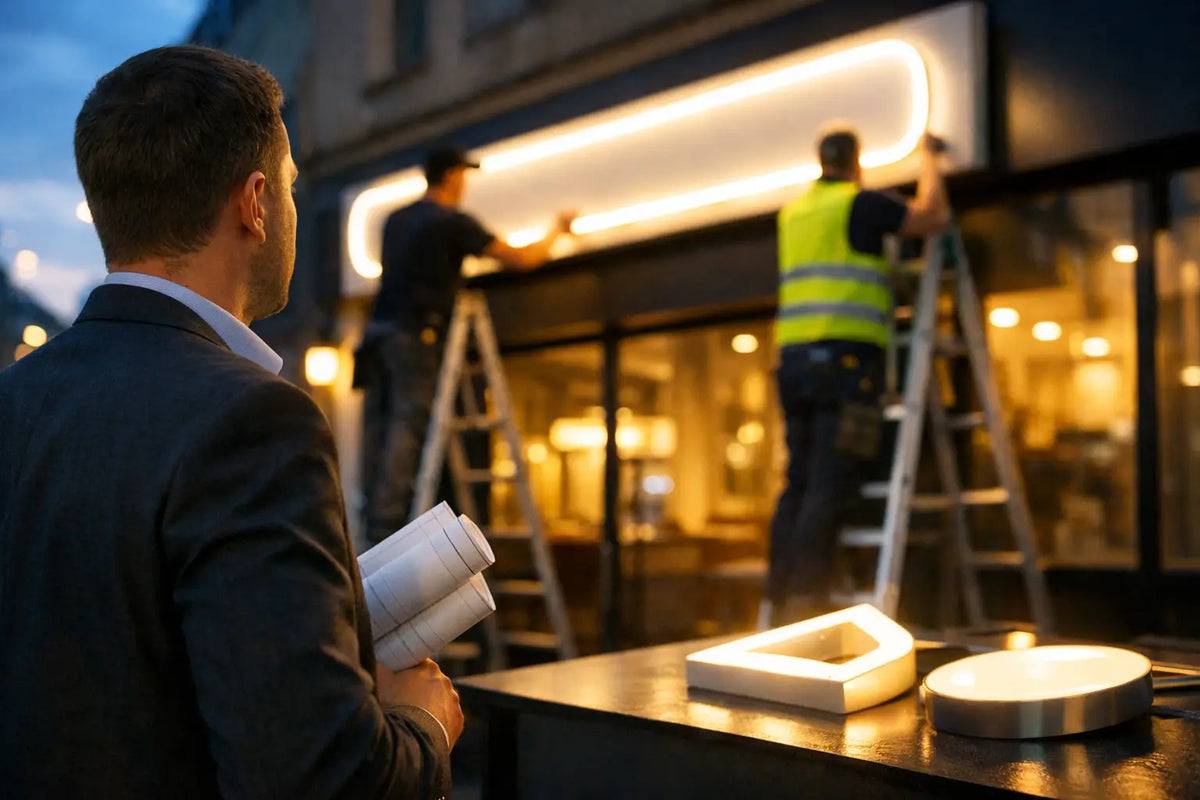
Some businesses you walk past without a second glance. Others stop you right from the other side of the street. That is the power of custom luminous signage—it doesn't just act as a sign for a shop, but as a first impression, an invitation, and a part of the brand's identity. When designed well, it doesn't hang on the wall just to light up. It works for you from morning until night, and often long after closing time.
For cafes, salons, showrooms, bars, or boutiques, seconds matter. People notice the color, shape, legibility, and overall atmosphere of a space before they read a single line of text. That is why custom-designed luminous signage makes more sense than a generic catalog sign. A brand's visual identity has its own rhythm, and a space has its own character. The signage should suit both.
Why custom luminous signage has a greater effect
Off-the-shelf solutions can be quick, but they often hit limits. They don't match the wall dimensions exactly, they don't work with the brand's colors, and sometimes they feel more like a compromise than a thoughtful move. Custom luminous signage is different because it is created according to a specific goal. Someone needs to increase visibility from the street, someone else wants to create an Instagrammable element for their interior, and another is looking for a clean corporate logo at reception.
The difference is also in how it affects the customer. When light is harmonized with the space, materials, and brand style, the whole looks more professional. This is not a detail for designers; it is a business tool. For prominent establishments, it often comes down to whether people remember them, take photos, or recommend them further.
Moreover, well-designed signage doesn't have to be aggressive. It doesn't have to scream to be seen. It can be elegant, clean, minimalist, or playful. It depends on the industry, the location, and the customer you want to attract.
Which forms of custom luminous signage make the most sense
Not every brand needs the same type of execution. For some, a LED neon sign is ideal, giving the space energy and lightness. For others, a backlit 3D logo works better, acting as a representative piece that anchors the corporate identity more firmly. Sometimes, a combination of both wins—for example, a logo at reception and a striking claim or slogan in a zone where customers take photos.
LED neon is especially popular where atmosphere and immediate visual appeal are the goals. It fits bars, cafes, beauty studios, children's play areas, event spaces, and home interiors. It has a more relaxed character, but with a good design, it can also look very clean.
3D luminous logos, on the other hand, are often chosen by companies wanting a stronger corporate impression. They give more weight to receptions, offices, showrooms, or representative entrances. If UV printing or multi-layering is involved, the result gains depth that a standard flat sign simply lacks.
Then there are decorative luminous elements that don't sell a logo directly, but rather the experience of the space. This is a common and smart move. A customer might not remember the exact font of a sign, but they will remember the place where it "looked great." And that is exactly what counts.
What determines whether the signage really works
The first is legibility. It sounds trivial, but that is where many mistakes happen. Overly complex fonts, weak contrast, or excessively long text reduce the impact. Luminous signage should be graspable quickly. People often look at it while in motion, from a car, or from the other side of the sidewalk.
The second thing is size and placement. A smaller sign might be perfect for an interior, but it will get lost on a facade. Conversely, an overly dominant element in a small space can feel intrusive. A good solution always stems from the specific site—the installation height, sightlines, daylight and evening light, and what surrounds it.
The third factor is the color of the light. Warm tones create a friendlier, softer atmosphere. Cooler or vividly colored light is sharper, more modern, and draws more attention. Even here, there is no universal answer. A different shade will work in a designer cafe than in a barber shop or at a development company's reception.
And then there is the craftsmanship itself. Quality production shows—in the details, the cleanliness of the lines, the uniformity of the glow, and how the signage looks after months of use. If light is to be a part of the brand, it cannot look cheap.
Aesthetics are fine. The result is even better.
Many firms treat luminous signage as a visual accessory. In reality, however, it often influences much more. It helps increase the recognizability of a business, supports brand memorability, and naturally increases the chance that people will notice the space. For businesses on busy streets or in commercial zones, this can be the difference between standing out and blending in.
It also has a strong effect inside the space. A luminous element creates an atmosphere that holds the entire interior together. Thanks to this, the business looks more finished, professional, and photogenic. This is more important today than many owners realize. When a customer shares your space on social media, the luminous installation often becomes a natural background. And that is advertising that people spread among themselves.
On the other hand, not every luminous installation has to be the biggest and most striking. Sometimes, a more subtle solution that supports the character of the place rather than overpowering it makes more sense. This is exactly where the value of a custom design shows.
How the journey from idea to finished implementation works
The best projects usually don't start with precise technical drawings, but with a simple idea. A logo, a slogan, a hand-drawn sketch, a photo of a wall, or just a sentence about how the space should feel. You can build more from that than most customers think.
The first step should be a consultation regarding the goal. Not just about what you like, but what the signage needs to accomplish. Does it need to be visible from the street? Should it serve as the dominant branding in the interior? Should it work mainly in the evening? Or is it a gift with personal value? When this is identified right at the beginning, the design is much more precise.
Then comes the visualization and the search for the suitable format, colors, dimensions, and technical solution. Here, it is important that the design is not detached from the reality of the space. A nice picture on a monitor doesn't necessarily mean the implementation will work well on a real wall.
Only then does production make sense. With custom solutions, it is not just about looks but also practicality—mounting, power supply, durability, and ease of installation. When the whole process is guided clearly, the customer knows exactly what they are getting and why it will work specifically for them.
When it pays to invest in a custom solution
If you are opening a new business, custom luminous signage makes sense almost automatically. It is one of the elements that sets the impression of the space from the start. However, it also works very well during a redesign or rebranding. Sometimes you don't need to change everything; one well-designed luminous element can change the atmosphere surprisingly quickly.
It also has great potential in homes—not just as decoration, but as a personal statement. In a bedroom, study, gaming corner, or above a living room bar, it can create exactly the type of atmosphere that a standard lamp cannot replace. With gifts, it also has the advantage of originality—it is not just another object for the shelf, but a piece of light with specific meaning.
It also pays off when you don't want to deal with compromises. As soon as you have a clear vision of your brand, interior, or message, a mass-produced solution is usually too generic. Custom production is the way to bring your own signature into a space without unnecessary improvisation.
What to look out for when choosing a supplier
Price is important, but it doesn't solve anything on its own. With luminous signage, what matters is what you get for it. Whether the process includes design, consultation, adjustments based on the space, and a warranty. Whether the supplier understands the difference between a flashy decoration and signage that also needs to function as a business tool.
A good sign is when someone isn't just discussing dimensions and colors, but asking about the placement, style of the space, and the purpose of the installation. This is what separates a purely manufacturing approach from a partner who knows how to translate an idea into a result. For brands like AtmoSvetla, it is this very connection that is valuable—a sense for atmosphere and visuals, combined with a clear focus on the final effect.
When light fits both the space and the brand, it is not just a pretty accessory. It is an element that helps you be seen exactly where it matters most.
💡 Do you want to design your own LED neon?
Try the online LED neon configurator — select your text, color, and size, and see the price immediately.